THE BASIC PHILOSOPHY OF BREEDING SPECIALTY ANIMALS
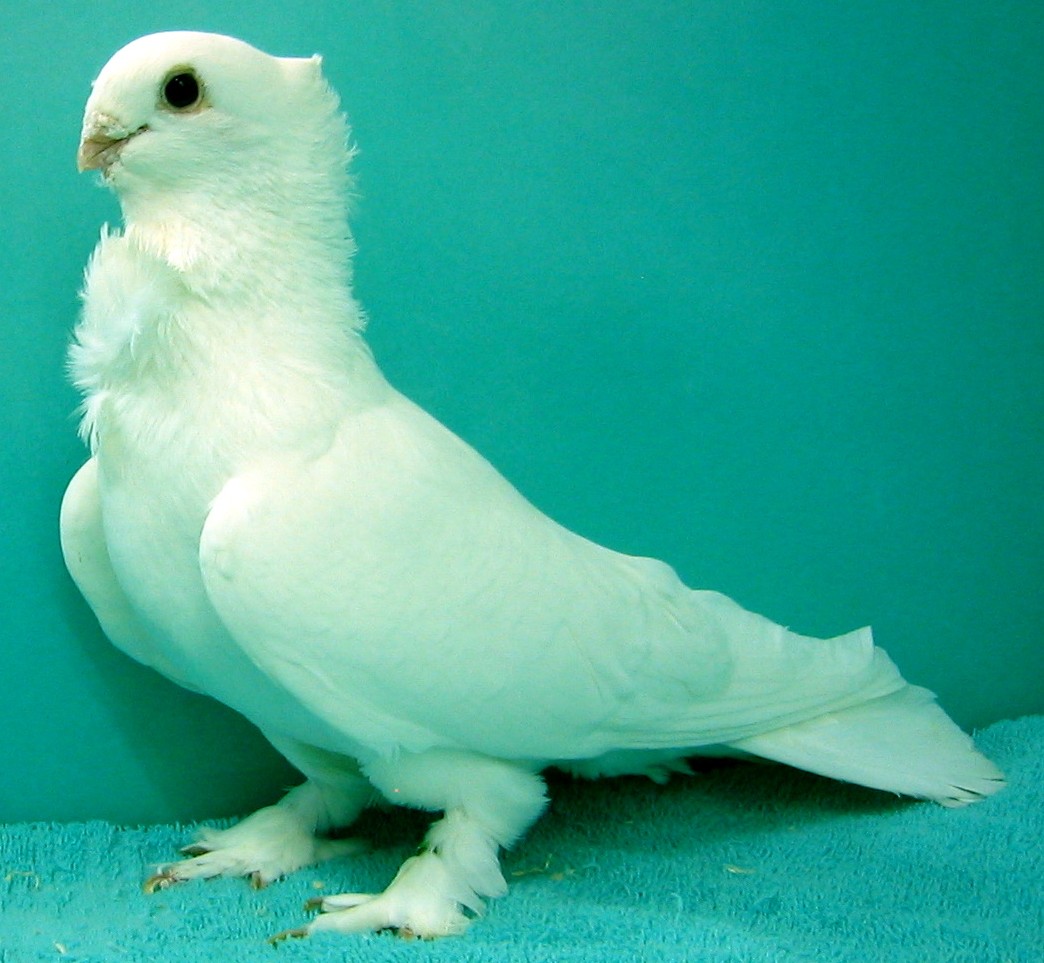
A Seraph cock out of the loft of Anya Ellis. This fine bird demonstrates the exquisite qualities of Seraphim created in a carefully planned breeding program. Outstanding features of this bird include the strong skull, downturned beak, needle-point peak, very deep unbroken mane, wonderfully full chest frill, prominent wing-butts held out from the chest, long beautiful line, finely feathered legs and toes, and overall angelic aura. This is a near perfect Seraph from the 2009 Show Standard.
If a choice is made to breed Seraphim, the fancier should always make every effort to breed from the best birds they have (or can get) and breed with a clear eye toward the Standard of the Breed. (Please refer to the article on The Show Standard.) This is true regardless of the purpose for maintaining ownership of Seraphim, and regardless of the number of Seraphim kept.
“Why?” you might ask. Good question. Let’s talk about it.

A visual of the modern Classic Oriental Frill Show Standard by Diane Jacky, as drawn for the National Classic Oriental Frill Club, Est 2003.
The only reason Seraphim exist is that an experienced Fancy Pigeon breeder noticed an unusual mutation in her loft and focused on it. Ten years of careful husbandry and genetic study finally led to the recognition of Seraphim as a separate breed or variety due to their particular combination of expressed genetic traits. Developed from the Old-Fashioned (Classic) Oriental Frill of the 1930’s type, Seraphim are substantially different in appearance and behavior from the Classic Oriental Frill of today due to the consolidation of their specific genetic traits by careful breeding. Like any designer domestic animal, Seraphim will vanish if their particular genetic characteristics are not kept and maintained within their gene pool. This is thanks to nearly forty years of painstaking work to refine and concentrate the genetic expression of their particular traits. In spite of the passage of so much time, the Seraph remains a Rare Breed. It is one of the newest recognized Fancy Pigeon varieties in existence and is not widely available. Thus, great care must be taken with the population in existence.

The 2017 Seraphim Standard of Perfection as depicted in the NPA Book of Standards.
The message is simple. If you love the beauty of Seraphim, you simply must properly maintain the genetic pool to be able to continue to see and enjoy them. Otherwise they will vanish.
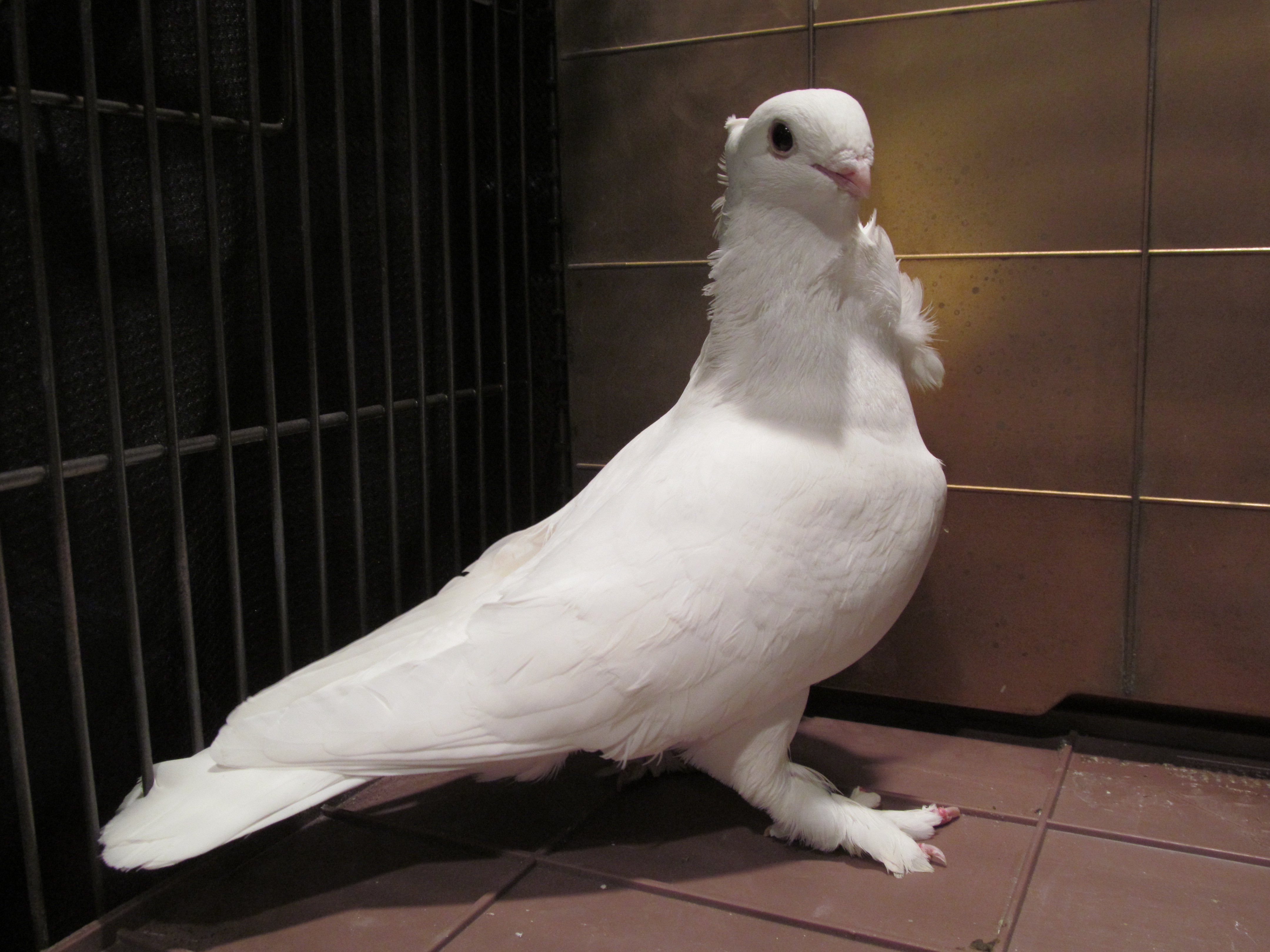
By definition, all Seraphim are related. None exist that did not originate from the original two males that hatched in 1986. The color genetics are set and well understood today, but the details that make the perfect Seraph structurally – like the enlarged skull, downturned pink beak, upright stance, curvy figure, long feathering, finely feathered toes, wing carriage, deep swoop and mane, huge frill, and personality are genetic traits inherited and expressed in more subtle ways that require constant care to maintain the breed. One must pay attention to all of these traits at once and carefully match up their birds to get babies that are as close as possible to the Show Standard. Always working toward that goal reinforces the inheritance and stabilization of genetic traits in the pool of breeding birds.
Breeding to The Show Standard can be very difficult, and sometimes it doesn’t work as expected. Seraphim are genetically complicated. How genes go together and are expressed can be very hard to predict. One must be prepared for failure as well as unexpected good luck. One must also be willing to experiment at times just to see what will happen if they try something new.
BEST METHOD FOR PAIRING YOUR SERAPHIM FOR BREEDING (To be read in conjunction with the article entitled “Sorting Your Seraphim.”)
The Purist Approach. This could also be called “Breeding Strictly to the Standard,” “Breeding to Win,” “Breeding for Show,” “Scientific Breeding,” “Pedigree Breeding,” or “Objective Breeding.” It is a process of strictly pairing best to best or pairing to eliminate flaws and enhance perfection. This is the gold standard. For those who are emotionally attached to their birds it can seem unappealing. Seraphim will self-pair if given the chance, and Seraphim pairs act as if they are in love and are generally monogamous. Splitting them up and assigning them to a different mate for the purpose of creating Seraphim closer to the show standard may therefore seem cruel. However, they are highly adaptable and will typically mate with the assigned partner regardless.
In an ideal loft, one has various rooms and compartments for their Seraphim. There is a room for Old Cocks, a room for Young Cocks, a room for Old Hens, a room for Young Hens, a room for Juveniles too young yet to be sexed, and one or more Breeding Rooms. After careful study and observation, the breeder will decide which birds he/she wants to cross each year in their attempt to create Seraphim that are as close as possible to the Standard. Those pairs will – usually in January or February, or early Spring if the loft is unheated – be taken to the Breeding Room where each pair will be temporarily locked into a breeding cage but separated by a see-through wire divider until their behavior indicates they have accepted each other and will bond to each other. The divider is removed, and once mating has occurred and eggs are laid, the breeding cage is opened so they can fly about in the Breeding Room and outside if there is an attached aviary. This technique assures precise parentage of the offspring, exact pedigrees (lineage of the young), and a relatively calm experience for the breeding parents. The breeder will soon see which pairs produce the finest specimens, and the next year the finest specimens will be used for the next breeding season. This approach constantly concentrates the best characteristics of the Seraphim flock. Many birds that are not used for the breeding program may be very fine specimens of show quality. Such birds often carry the necessary qualities to produce outstanding offspring and can be sent to other pigeon fanciers to work with. Such choices can be very difficult and might even prove to be wrong, but the advantage to a fancier looking for a pair or more of Seraphim is that the breeder with such a controlled program will choose the best birds from their non-breeders for sale, and with careful technique the new owner can expect to bring out the same superior show characteristics as the original breeder.
What if you don’t have space to separate your birds into categories in various pens as described above, yet you want to breed for Show and constantly improve your flock? “The Purist Approach can still be used in a single small room by using breeding cages for every pair for every round of breeding you allow. By carefully sorting your young birds every year (See the article on “Sorting Your Seraphim”) you can maintain your small flock for both show and breeding and personal enjoyment and provide high quality birds for other fanciers at the same time.
The main thing is to be thoughtful about controlling the breeding process. Even if you have no intention of showing your Seraphim, they should still be bred as if you do. Thus, the breed can constantly be improved and standardized. Don’t create lots of birds you don’t have room for or don’t know what to do with. You can control populations in various ways, such as limiting artificial light (Seraphim will cease laying eggs in the winter during short days), replacing eggs with faux wooden eggs and selling extra Seraphim, or giving them away to others who want some for their back yard dove cote.
THE BREEDING PROCESS: How it works, and what to expect.
Seraphim can successfully breed as early as eight months of age, though when starting so early they may have a couple of sterile clutches before finally having success. Most breeders would recommend waiting until 10 months of age to assure that maturation has been reached and one can expect a healthy reproductive cycle. Young cocks will generally declare their gender by four months of age when they become more aggressive and begin the classic courtship dance of pigeons everywhere, cooing loudly, standing very tall with neck feathers fluffed out, fanning their tail, and puffing up their crop. The hens, for their part, at about the same age may softly coo in response and even demonstrate a little dance themselves, bobbing their heads and lightly flicking their long flight feathers, puffing up, and fanning their tails; but their display is dramatically subdued compared to the male. It can be very difficult to determine the sex of young Seraphim up to even eight months, as both sexes will demonstrate some of the same behaviors up to that point and the cock’s cooing and dance may be a little pathetic until the full force of testosterone hits. Hens may even mount cocks at this age and seemingly go through the mating act while the cock allows it. This is why juveniles are, when possible, housed in separate quarters until it can be deduced who is whom. Adults are often very nearly the same size, so one cannot use size to determine the sex of the bird, except that the male head is usually larger and wider. Hens may become very impatient with other hens at maturity, pecking them and yanking out a feather or two and knocking them off the perches when given a chance, all of them vying for attention from the cocks.

A Seraph cock dancing in full courtship display.
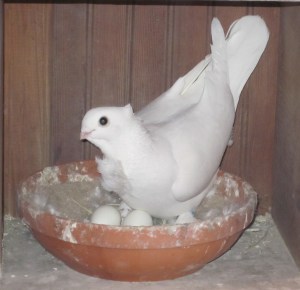
A winning dance, apparently. The Seraph cock with daytime nest duties.
If you purchase a single pair, they may essentially be strangers to each other, and it will take a few days for them to settle into their new home. They will explore it carefully, as they are quite inquisitive little creatures. Very quickly they (almost always) will be bonded and be looking for a nest site, so if you intend to control the location of the breeding area in the loft, be prepared to place a nest bowl, box, or breeding cage within a week of the pair’s arrival, or they’ll pick their own spot someplace and begin building a nest on a secluded portion of a ledge. Also be sure there is plenty of grit and oyster shell calcium available at this time during the breeding cycle, and that you are using a high protein breeder mix for feed, at least 18% with added peas and safflower throughout the entire time period.
Seraphim, being a bit shy, prefer more privacy in their nest sites than some other breeds; a dark nest cavity that can be crept into is preferred, no larger than a 12-inch cube. Clay nest bowls can be obtained from Foy’s Supplies; they have air holes in the bottom to prevent condensation and are heavy so they can’t tip over. Add a coconut fiber pad to the bowl. As soon as the nest bowl is placed, the cock will fly over to inspect it and begin a dramatic display, calling the hen over to take a look. If she likes it, she’ll begin making low-pitched sounds, puff her feathers, and slink into the nest bowl on crouched feet, flicking her flight feathers. She may crawl right under the cock and remain there cuddled with him. The two of them will spend many hours cooing and billing while sitting there together. This will go on for a few days, and then the cock will begin loading up the nest with sticks and twigs while the hen stays put. She will spend longer and longer periods of time in the nest bowl.
About this time, you may notice some other behaviors. The cock will stay beside the hen closely, no matter what is going on in the loft. At feeding time, he will chase her around, pecking lightly but urgently at her back, barely letting her eat. He will aggressively chase any other suitors away from the hen. The hen will start taking more calcium. The pair will begin to spend more time away from the prepared nest and the rest of the flock, seeking a space of solitude where they cannot be interrupted. They will find a secluded place on a ledge or in a corner on the floor. Here there will be a lot of billing and posturing. The cock will walk repeatedly around the hen. The hen may crouch intermittently, flicking her wing lightly on one side. At some point, the cock will stand tall, turn his head, and reach over his back and repeatedly comb one of his long primary flight feathers. This is the sign that mating is desired and about to occur. Critically, though, the hen has to respond with precisely the same combing motion, or the invitation to mate will be deemed a failure by the cock, and he’ll once again begin walking around the hen, bowing and cooing and attempting to get her in the mood. When the hen responds back to the cock with the same head over the back combing motion, they will alternate the motion back and forth for a few seconds, and then the hen will abruptly crouch very low to the ground, head down and tail slightly up. This is the invitation to mount (tread) that the cock has been waiting for. He will carefully step up, and with a brief flapping of wings touch his cloacal opening to hers, and the deed will be done. He will then prance around like the king of the universe while she first puffs up and shakes out her feathers (much like straightening a dress, comically). The cock will then loudly fly up to the nest, wings popping against each other, and the hen will follow. A few such matings will occur in the days leading up to egg laying.
Once the hen has laid her first egg, you will notice the cock sitting – alone and unmoving – in the nest bowl during the day, even if you walk close to the nest. Don’t go any closer. He will just stare at you. You don’t want him to bolt, as his stillness is evidence that an egg is present. Mark the date, as it will hatch in 18 days, and you will need to be ready to check the youngsters soon after hatching to make sure all is going well. You can assume there will be another egg the next day, as pigeons almost always lay two eggs one day apart. Once the clutch is complete, the cock alone will incubate the eggs during the daylight hours and the hen will incubate during the night.
At seven days you may carefully flush the cock off the nest to see what is going on. By then the cock is strongly attached to the nest and will return immediately when you leave. The eggs can be examined to check for fertility. Shine a penlight through them or use the flashlight app on your cell phone. If fertile, you’ll see the embryo surrounded by blood vessels overlying the yolk sac. Put them back and don’t bother them again. If they are not fertile, they can be removed to stimulate another round of egg laying within a couple of weeks. If one egg is fertile, leave them both. On the last day or two of the incubation cycle, you might notice that the hen is sometimes on the nest during the day. She knows the eggs are about to hatch. Don’t bother the nest or parents at all at this stage.
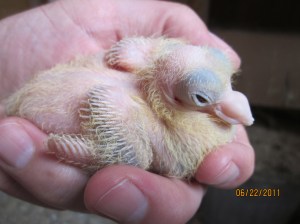
A very sleepy 5 day old Seraph chick.

The same little twerp @ 4 weeks, nearly ready to leave the nest.
With any luck the eggs will hatch at 18 days. The babies are tiny and covered with a light golden down. It doesn’t seem possible that they could be strong enough even to eat with assistance, but miraculously they do. You don’t have to check the nest right away. If you watch the parent for a while, you will notice him/her checking underneath periodically; you may hear peeping, and you may notice the parent shifting position fairly frequently. You might even see a little head pop up. Both parents will feed the babies a mix of “crop milk” the first couple of days, followed by crop milk and seeds they regurgitate into the babies’ beaks, and eventually just seed mixed with water. The hen will sit very tight on the young the first day or two, and then she’ll finally let the cock take over with intermittent breaks. If there is still an infertile egg in the nest, this is the time to remove it. You will need to walk carefully to the nest and flush the parent off, as you need to check the health of the baby within two days of hatching. Its little crop should be full. If it is thin and peeping hysterically, then it is not being fed. If there is an unhatched egg beside it, remove the egg now. If the baby looks fine, then leave it alone for the next week while the parents are attending to it. Within ten days both parents will check on the young periodically, but they otherwise will leave them alone except for feeding or sitting next to them in the nest at night. The young grow insanely rapidly. What was a mere fluff on day one is a big fat squab at six days and is ready to be closed banded with a size 9 or 10 band by day 9 or 10. One can order bands from the National Pigeon Association as well as other sources. Show Pigeons are to be closed banded, i.e., the band is circular and without a seam; it has to be slid over the squab’s foot onto the portion of the leg just above the foot before the foot is too large. Otherwise, the band simply won’t fit, and the bird can only be banded with a seamless band. Birds without seamless bands can generally not be shown in competition.
By four weeks the young are nearly fully feathered and almost ready to leave the nest. In an ideal world they will stay in the nest until they are five weeks old and truly fully feathered, but they often leave the nest in a controlled loft a bit early. By this same time, the cock has often already scouted out a new nest site if one is available and is encouraging the hen to lay another clutch. Once the new clutch is laid, the cock again resumes his daytime incubation duties but also attends to the older chicks which may now be running around on the floor of the loft, feeding them and teaching them to use the feeder and water source, which they learn quickly. He will do double duty until the next chicks hatch, and by then the older ones are already up on a roost and managing on their own.
Youngsters can be left with their parents for many months as more and more offspring are added. The parents tend to be tolerant of their own until they reach full maturity at eight months or more of age. As long as there are plenty of perches and the older juveniles stay away from the parental nest box, a large family of Seraphim will get along quite well. If space is tight or squabbles are noted, it is best to move the older youngsters out to their own pen so the parents can have some peace.


 The Seraphim Club International