By David D. Coster
The story of Seraphim started as an unexpected event. To tell the tale, we have to go clear back to 1986 and the original tiny loft of Anne (Anya) Ellis near Milan, Illinois, USA. That year, Anne could best be described as a novice pigeon keeper who had been searching for specimens of the beautiful Classic (old-fashioned) Oriental Frill pigeon. Knowing little of Fancy Pigeon breeds, the National Pigeon Association, pigeon competitions, and the whole world of pigeon breeding and pigeon fanciers, she had started out years previously with a wild pigeon, then graduated to a few homers, and finally ended up with Classic Oriental Frills one day after seeing one perched on the loft of her friend Art Grammens.
The breed was no longer common, having largely been replaced by the larger, short-beaked Modern Oriental Frills in the mid 1900’s. Over time, as she gradually collected more specimens, Anne studied the colors and patterns displayed in her flock and began to learn everything she could about them and their color genetics. One color she never found in her search for new Classic Old Frills was red, a color she really admired in Modenas, so she went about trying to find a way to get a beautiful red in her little flock of Classic Old Frills.
Determined that she was more likely to get the red she wanted with a little help, she took some of her Classic Old Frills over to Bob Pettit for a color genetics consultation. Out of that bunch, he identified one that he was certain was carrying a recessive red gene and told Anne to use that bird to get started in her effort to create a red Satinette Classic Oriental Frill. She paired the blue bronze-bar cock Bob had identified as carrying recessive red with a brown t-pattern toy stencil hen. Incredibly, the hen was also carrying recessive red unseen, and the first two babies were both recessive red. The odds for such a stroke of luck were low, and yet it happened. Unfortunately, the cock died while the babies were young, but the hen went on and raised them alone, another stroke of luck.
Over time it became clear that the red in the two youngsters was not the beautiful “improved” recessive red Anne had seen before in Modenas. The babies had dull reddish-brown feathers in a Satinette pattern. As the first molt began, brighter red feathers did not appear either. Instead, white feathers began to replace all the red ones. This was not what she had expected. The experiment to create red Satinettes had seemingly failed. She had to find another way. The two failed birds were placed with the rest of the flock, and she stopped paying attention to them.
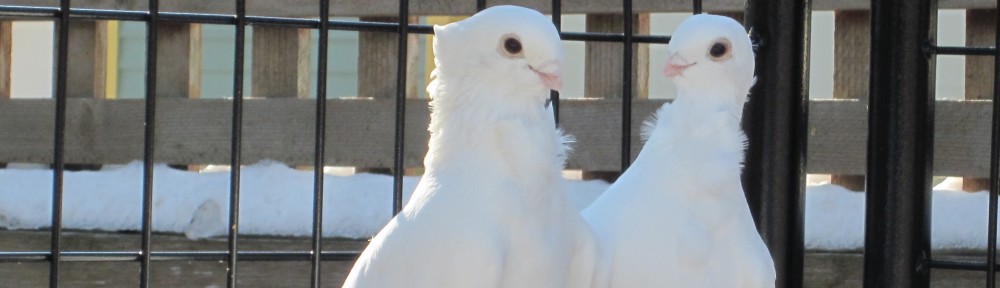
One morning a couple of months later she went out early to the loft just as the sun was peeping into the window where the two little disappointments had been perched for the night. Both were sitting in a beam of sunlight. All the red was gone; the two young birds were pure white. The light reflection cast a halo around them. “Angels!” she thought. She had paid so little attention to them the previous two months that she had not seen until that moment that the two youngsters had molted into the purest, dazzling, entirely white adults one could imagine. She stared some more. “They look like Seraphim,” she thought. And that’s how the “White Angel of the Pigeon Fancy” first appeared, and that’s how they were named.
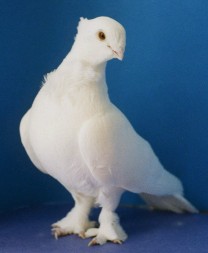
This is B1, the first known bird with Seraph color genes in existence. All Seraphim trace their ancestry back to him and his brother, W1.
Anne captured the brothers and raced over to Bob Pettit. “Look what happened!” she exclaimed. “It’s something new!” She wondered if this could be the start of something. Maybe whatever happened to cause this could be replicated. Maybe this could be the beginning of the color project she had been looking for, or maybe she could even create a new breed.
Bob pointed out that the cause or source of the mutation(s) that had turned the two birds white was not known. Anne had to dig deep into science and history now to figure it out. Bob patiently explained that the scientific process to create a new breed was an arduous one, but she wanted to see what she could do with these two unusual birds.
And so, she began. She paired a sliver hen with one Seraph cock (B1), and then backcrossed the first generation (F1) back to B1. This resulted in the transmission of the recessive red genes and the unknown genes that turned the birds white in 50% of the offspring, all of which were cocks. A brown Satinette F1 hen out of the “B1” line was paired to B1’s brother, W1 – the other original Seraph cock, which finally resulted in the first Seraph hen in 1988. A Seraph hen didn’t appear in the “B1 Line” until 1991 – thus, Anne had to keep pairing the over-abundant Seraph cocks from the B1 line with “split” hens – F-1 birds that carried half the Seraph color genes, whatever those were – to get the Seraphim project off the ground. The “split” (heterozygous) F-1 birds were named “AIM birds” by Anne’s friend, Ralph Marerro, because they were, he joked, “aiming to be Seraphim.” Her best AIM birds were her “Seraphim in disguise” until she produced that first Seraph hen in 1988, finally allowing her to pair Seraph to Seraph and paving the way to fast track the process of establishing the new breed, her ultimate goal.
Over the next seven years the breed was imagined and defined by careful selective breeding using both the B-1 and W-1 lines. Little by little she refined what the Seraph was supposed to look like. The feathers gradually lengthened, giving the birds bigger frills, longer flights and tails, and a frillier ornate appearance. Likewise, the physical form was gradually shifted to become more svelte, with concave shoulders, a narrower chest, and a more upright posture. It was an effort to create a work of art, a living sculpture, through both selective breeding for structure and selective breeding for color genetics. Meanwhile, she began attending to the needed breeding experiments to determine the color genetics behind the transformation to white in her Seraphim. Historically there were reports dating back to the 1940’s in America of recessive red Modern Oriental Frill pigeons gradually becoming paler and paler over repeated molts until they became almost white, but they always had a trace of pale red remaining. This was called “the red problem” back then. No one had an improved red in Moderns even though they tried and tried. They always faded. There is no historical evidence for, or any written record of, a successful recessive red in Classic Old Frills in the United States either (until just recently – see The Magic of Seraphim Genetics). The breed fell out of favor with the introduction of the Moderns, and Classic specimens became very difficult to find by the 1960’s. No one wanted them, and no one was working on color.
Bob Pettit helped Anne, searching far and wide for old-style (1930’s era) Old Oriental Frills with the characteristics she needed to achieve the creation she envisioned, and then introduced her to Doc Hollander, who designed a breeding experiment using self-recessive red wild-type pigeons to understand the color genetics involved with Seraphim. Dr. Hollander worried that Anne had too little space in her loft to do the necessary breeding trials to sort out the color genetics of Seraphim, so he engaged Tim Kvidera to take some of Anne’s Seraphim to his large loft in Minnesota to perform breeding experiments. Here he determined that the recessive red gene in Seraphim was linked with the “White-Sides Gene.” The source of the tail whitening genes could not be determined but they seemed to be linked to both the Recessive Red and the White-Sides Genes in some way. The White-Sides and Tail-Whitening mutations could be split apart in these experiments though with intergenerational and generational crosses, producing visual rose wing, white sides, red tails, white tails and various red patterns on the head, neck and chest, as well as Seraphim. The experiments required many generations and backcrosses, so the answers came in slowly as the work of refining the breed in Anne’s loft continued. Although the wing and tail color changes could be split out, it appears that there was likely some linkage and perhaps some other factor that was causing the color change to be an immediate one when it occurred, rather than gradual.
By January 1995, nine years after B1 and W1 first appeared, Anne had met the National Pigeon Association requirements of showing five Seraph cocks and five Seraph hens at three consecutive Grand National Shows. She had written the first show standard for Seraphim and had given a presentation to the Board of Trustees on the new breed. Her work and that of her friends and associates paid off, and Seraphim were officially recognized as a new breed by the National Pigeon Association.
In December of 1995, Anne met Jean-Louis Frindel at the German National Show in Nuremburg, Germany. Jean-Louis, of Lalaye-Charbes, France, is the artist who paints the pigeon standards for the German and European Standard books. He was taken by the beauty of Seraphim and decided that France should be the first European country to officially recognize them. As hoped, The French National Pigeon Association (SNC) was the first in Europe to recognize Seraphim in 1997. Arrangements were made for a story about Seraphim in the French pigeon magazine, Colombiculture, with Anne featured on the cover holding one of her prize Seraphim. The story was a hit, opening doors for articles on Seraphim in other European pigeon magazines. Anne spoke about her experience at the Centennial National Show in Chambery in 2003 and in a European film about Fancy Pigeons. The most memorable connection created by the article was with Gabriel Thomas of France, who fell in love with Seraphim and wrote Anne hoping to acquire some to help him recover from a personal life tragedy. It took two years to finally get birds into his hands in the Brussels airport and it was a big moment for both Anne and Gabriel. Through him, Jean-Pierre Demuyter and Rene Dautel (a French judge) joined the Seraphim Project.
Contributions to the development and promotion of the Seraph breed were made by many others, including Terry Fick, Everet Uhls, Raul Delgado, George Simon, Gottfried Ernst, and David Coster. Anne is indebted to all who advised and assisted along the way.
Today the Seraph Show Standard has been firmly established, with the newest Standard announced in 2017. (See under Show Standard in the side bar on this site.) The color genetics have also been worked out to a finer degree (See under “Genetics” in the side bar.) The discovery of “controller genes” and “gene switches” have allowed for a better understanding of how pigment production is turned off in Seraphim to create a pure white bird. Finally, new information from Professor Axel Sell in Germany has hinted at a probable ancestral genetic connection of Seraphim to a rare color variety of Uzbek Tumblers called Tschinnies which may explain their color change. (See under Genetics in the side bar on this site).
Anne’s work for the Seraphim Project had the unexpected side effect of renewing interest in Classic Oriental Frills across the United States. She became highly expert in their color genetics and introduced the breed to many fanciers while working on Seraphim. With her support, the Old-Fashioned Oriental Frill Club was established in 2003 by friends of Anne – Harold Collett and others – and today Classic Oriental Frills are one of the most popular breeds in the United States. (See Club History at the Classic Oriental Frill website at http://www.classicoldfrill.org.)
David Coster, Manager, SCI
 The Seraphim Club International