Seraphim: Does Color Matter?

Based upon the history of how the Seraphim breed was developed as well as the results of test crosses to determine their genetic makeup, the color genes known to be present in Seraphim are: Recessive Red (or yellow if the dilute gene is present), Satinette Piebald, Dominant White Flight, White-Sides, and some unknown genetic factor(s) that seem to be linked to the White-Sides gene that also turn the tail white, i.e. “tail-whitening” genes. This gene combination is called the “Seraphim Color Gene Complex.” (See articles in the “Genetics” sidebar for details.)

As for visual appearance, Seraphim MUST as juveniles be recessive red or yellow and the color distribution MUST be specifically in the Satinette pattern, i.e., colored wing shields and tail. The head, neck and body are piebald (white), along with the 10 primary flight feathers. The Satinette pattern does not have to be perfect in young birds (it is difficult to breed a perfectly marked Satinette), but the pattern must be apparent. With the first molt, red or yellow feathers are replaced completely with white. Typically, a Seraph is pure white by 9 months of age when it reaches sexual maturity.

img020

The above old archival photo shows a white Seraph cock from the early 1990’s with his juvenile red Satinette offspring. This six-week-old baby is mismarked and overmarked, but you can see that the underlying visual color pattern is Satinette Piebald. The discontinuation of pigment production occurs after juvenile feather formation. All red feathers will be replaced with white with the first molt.

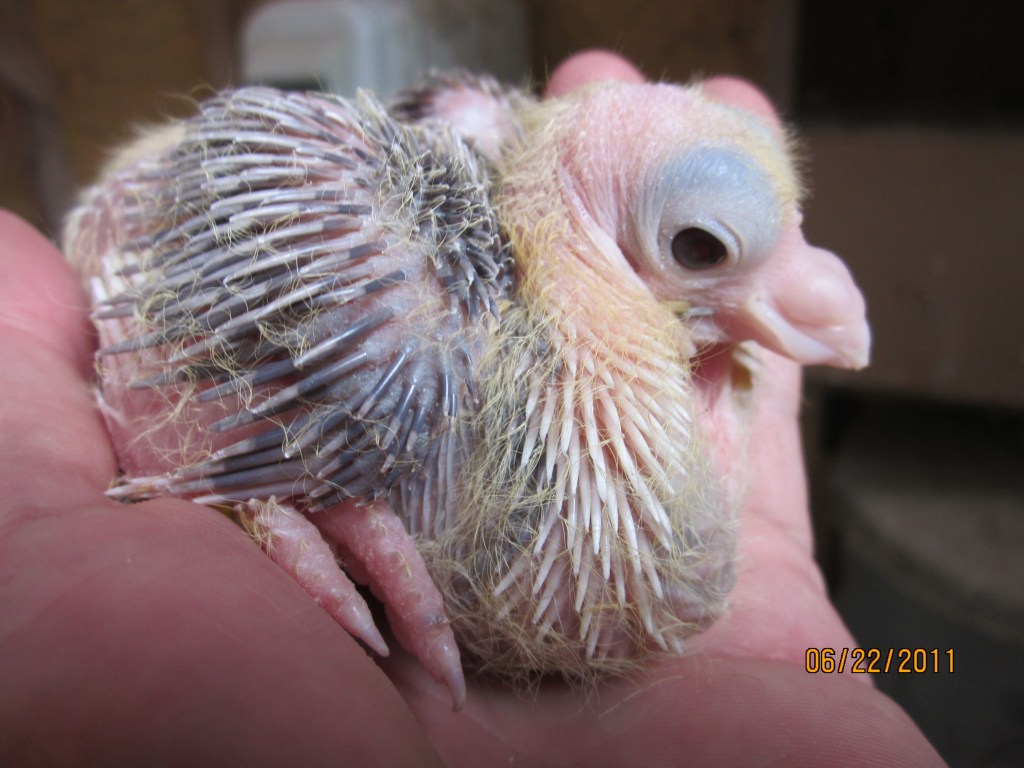
First baby out of NoBand and Snow. 2012. One month old.

The above 2012 photo of a little Seraph demonstrates the Satinette pattern of the juvenile: red wing shield and tail with white everyplace else. Note that the color is muted compared to the red juvenile in the previous picture due to the presence of the dilute (yellow) gene. The Satinette markings are perfect in this baby – there are no mismarks in the white feathers of the body, neck, and head – but perfection is not required (only desired) in the juvenile color phenotype (appearance), as long as the proper color genotype (the necessary genes for the basic Satinette pattern) is present. You can see this baby is a “lacewing, lace-tail” specimen now, but you won’t be able to tell that in eight months when it has become pure white. The presence of the Satinette pattern in recessive red or yellow confirms the genetic color pedigree of the young Seraph.

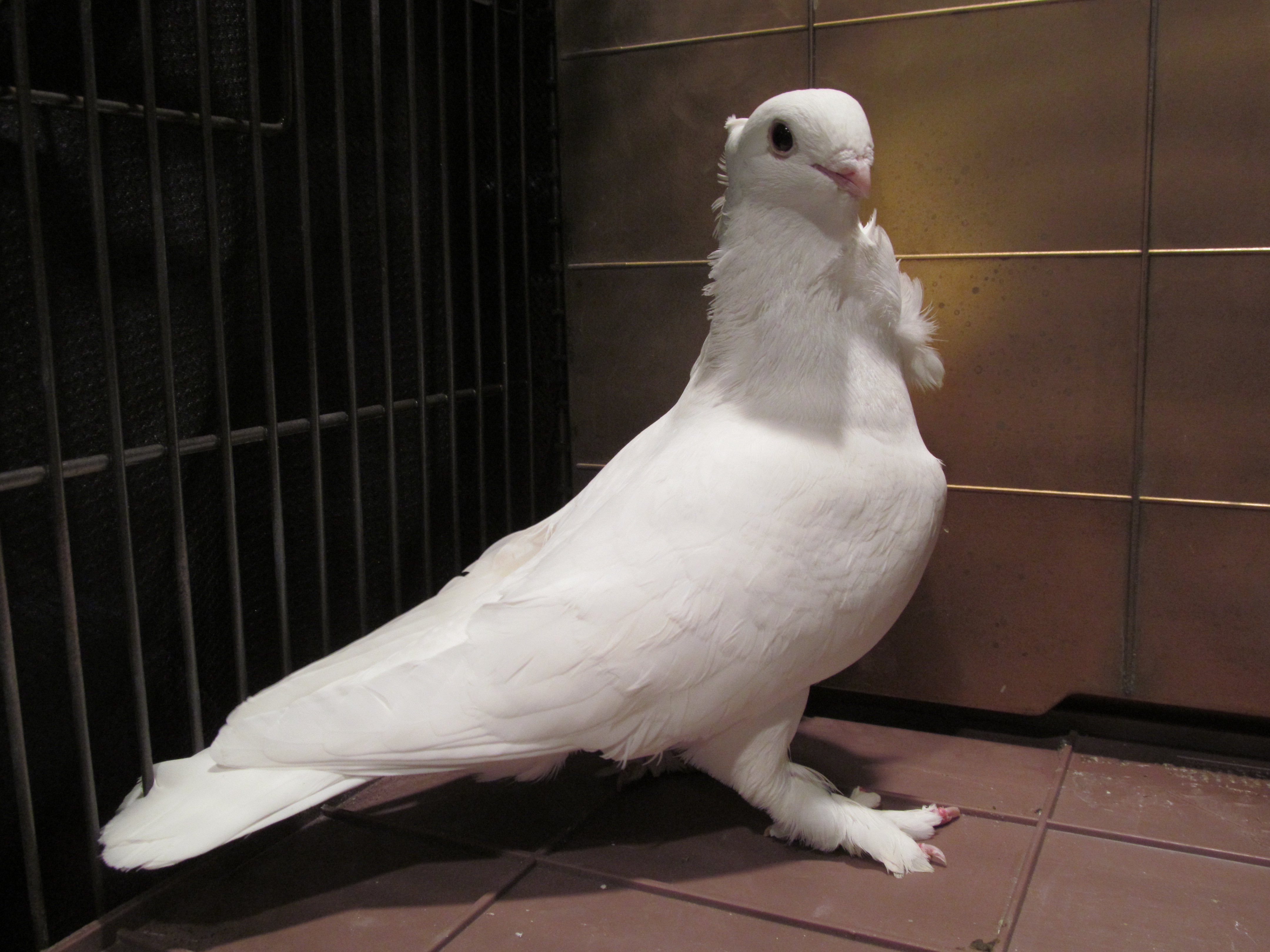
When the first molt is complete by 8-9 months of age, the young Seraph will be pure white – as demonstrated in the photo below of the baby from the above photo taken at the Des Moines ISPA Show eight months later. The transformation to white in Seraphim due to the Seraphim Color Gene Complex is what is different about the white of Seraphim. There is no transition period; no gradual or progressive change to white over successive molts – it is immediate with the first molt. A particularly beautiful young Seraph cock.

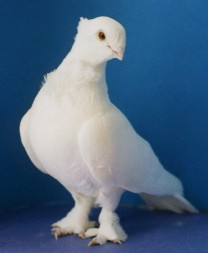
The bird above demonstrates the structural requirements for Seraphim today. The flights and tail must be long, the frill is expected to be huge, the peak must be a fine point and rest lower than the top of the skull, the mane must make a perfect line in the back, the swoop must be deep, the toes must be finely feathered to the ends. the wing butts must be held away from the chest, the posture must be upright, and the shoulders must be concave. This is a particularly beautiful show quality Seraph.

As Seraphim are a work of art, structure matters above all. But, yes, even though the adult is pure white, color does matter in Seraphim, as it confirms the underlying presence of the Seraphim Color Gene Complex in the young bird. The initial color must appear with original quill formation in the nest, it must be recessive red or yellow, the pattern of color distribution must be Satinette, and the color must vanish and be completely replaced by white with the first molt.

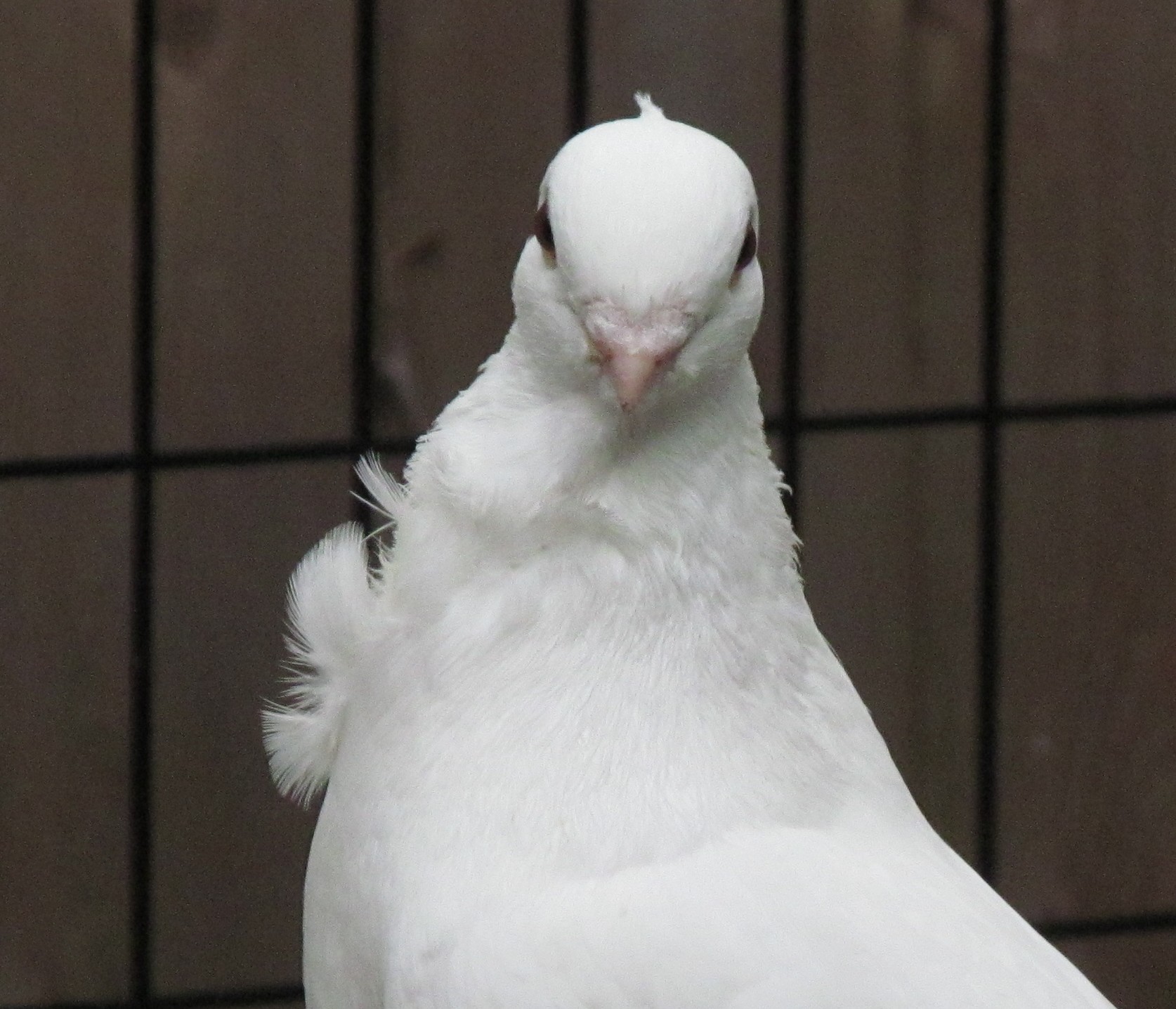
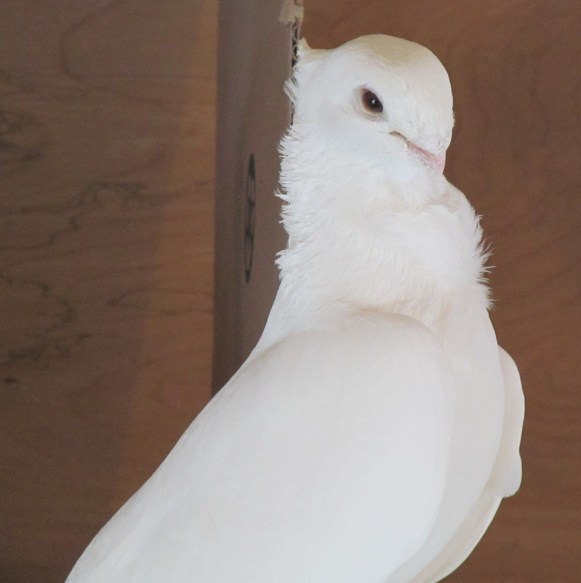
Seraphim are a unique breed defined by their color genetics and the results of decades of selective breeding which has changed feather length, posture, body shape, skull shape, and feather ornamentation. They are considered one of the most visually exquisite breeds of Fancy Show Pigeon today. They were designed specifically to be fancy works of art. They are not performance birds – they are meant to be admired. The decades long process to create their angelic and regal appearance while yet maintaining their strong natural constitution was an arduous combined artistic/scientific endeavor requiring the input and help of many experts.

David Coster

Evaluating Your Birds for Show Qualities

If you have become a Seraphim owner for the purpose of creating a loft full of Show birds, please refer to the article on sorting your Seraphim, the article on the 2017 Standard of Perfection, and the article on how the new Standard was developed to understand what is expected of the modern-day Seraph. To show your birds and maintain the breed, you must apply everything you learn here to the sorting process as you evaluate the quality of your own young birds each year. The best birds should be kept for your own breeding program or sold specifically to serious breeders of Seraphim to steadily improve the quality of Seraphim all over the world. Birds that are far off the Show Standard should not be used in any formal Seraphim breeding program. The following article uses the Standard in the order of judging to help you learn to properly evaluate your birds. This sequential approach should become second nature for the serious breeder. In 2017 and on, the new Standard of Perfection developed by Anya Ellis will be the goal for all breeders.  The 2017 Standard of Perfection has small changes, but the changes significantly affect the overall appearance of the bird. To make it easier to understand the judging process and how to use it to critique your own Seraphim, I’ve included representative photographs alongside the written requirements from the Standard to show good and bad traits; each photograph is critiqued in a strict manner.

If you have Seraphim simply for your own personal enjoyment in a backyard loft/aviary and have no Show aspirations, it is still useful to understand the Show Standard and what Seraphim should look like.

APPLYING THE STANDARD OF PERFECTION TO THE EVALUATION OF YOUR OWN SERAPHIM: YOU BE THE JUDGE!

“OVERALL IMPRESSION: Adult Seraphim have the appearance of a white angel. They are statuesque and elegant.  When stationing the head is held high, the tail low with the chest projected upward and forward. The frill is prominent and the wing butts are clearly delineated from the body. The flights rest on the tail and the back is smooth, lacking ‘sails’ in the covert feathers. The feet are covered with small feathers and a sweep of ankle feathers giving the appearance that Seraphim have white stars for feet. Hens will appear somewhat more delicate and refined than cocks.”

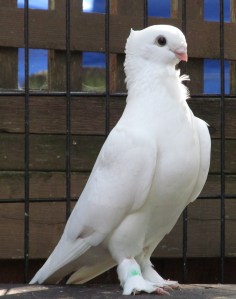
Toughy 2012. A perfect young cock.

#1. Let’s pretend the Seraph at left is your young bird just lounging around in your loft. You went out to feed them and noticed him standing there looking at you. Hmmm. You automatically start assessing him. He is demonstrating the statuesque overall look expected of a Seraph. He clearly shows: “the head held high, the tail low with the chest projected upward and forward. The frill is prominent and the wing butts are clearly delineated from the body. The flights rest on the tail and the back is smooth, lacking “sails” in the covert feathers. The feet are covered with small feathers and a sweep of ankle feathers giving the appearance that Seraphim have white stars for feet.” This bird clearly meets the basic initial overall expectations of a Seraph at first glance. Critique: Though the frill is prominent, it is too small for what we expect of today’s Seraph. The feathers are tight, i.e. not quite long enough to give the bird the maximum frilly appearance desired in Seraphim. There are some other minor issues with this young bird that would keep him from first place at a show, but his general appearance is solid for a Seraph. In show stance his attributes will become more defined. Here, at rest, he demonstrates power, elegance, and confidence. This bird is still a baby – see the red secondary flight feather on the wing? He is not yet done with his first molt. 

“The head is the most heavily weighted feature in judging Seraphim.  The curve from the tip of the beak to the tip of the needle point peak is unbroken. The head is rounded, and the beak is down set and large enough for Seraphim to feed their young. The eye is bull and the cere is unobtrusive and very light pink or almost white in color. There is a medium gullet that adds weight to the head. A convex and unbroken mane flows from the tip of the peak to the shoulder. Seraphim have a prominent chest frill.”

2. Look again at the bird above and make a summary evaluation of the head. If the head is bad it takes just an instant to decide the bird must be removed from your breeding program and should not be sold to a serious breeder or taken to a show hall. It is very difficult to develop a line of Seraphim with great head characteristics, so find the very best you can to start with in your loft. The bird above has a very large skull (highly desired) and a smooth “curve from the tip of the beak to the tip of the needle point peak…” It is very hard to refine the peak to such a fine tip, but the Seraph above has it, so take note. “The head is rounded (the head in the above bird is not quite round enough (too oval) and the swoop is not deep enough) and the beak is downset (pointed downward) and large enough to feed their young. The eye is bull (almost black) and the cere (the skin around the eye) is unobtrusive (not built up, just barely noticeable).” There is a medium gullet. (A gullet is a central skin fold that extends from the base of the beak down the midline of the neck below the chin, disappearing into the chest feathers – it creates a little shadowy groove on each side along the throat. The gullet in the above bird is present but not large enough to be adequately apparent.) The Seraph above has all of the things he’s supposed to have – he passes the initial “once over” by the Judge! Now, though, the Judge will make a second pass, refining his evaluation and critiquing every aspect of the Seraph in front of him/her; some of this evaluation will be done from a few feet away and some will be done with the bird in the Judge’s hands. The bird above would be judged as simply “Superior” on the date of the photo. He is a very good Seraph but will not win. 

Let’s continue on through the Standard and instructions for YOU – the Judge:

ORDER OF JUDGING:
Station
Head
Peak
Neck
Mane
Tail
Frill
Foot

TRAITS TO BE JUDGED DURING HANDLING:
Eye
Foot
Condition
“Foot, Eye, and Condition are all to be judged during handling; all other qualities are to be observed in the show cage. Some eye faults can only be seen during handling; the foot should be closely evaluated for feather nubs indicating the toes are not bare; the body must be felt for physical condition and feathers must be inspected for lice, holes, and dirt. Stress can alter the stance, feather tightness, and overall appearance of the bird, so they must be observed in a calm state in the show cage before handling in order to form an accurate impression of the bird’s actual quality. The back may arch in a stressed bird; the head may become boxy in a stressed bird; the peak may lower and become twisted or tufted in a stressed bird; a mane break may appear in a stressed bird. If a bird is stressed the Judge should come back to it once it has settled.”

BREED CHARACTERISTICS
“COLOR: (10 points): Recessive red or recessive yellow that molts to white. Young birds will often retain some colored feathers through the first year. This is not considered a fault in young bird competition since it proves birds are indeed young Seraphim. FAULTSFailure to molt to white in two seasons. DISQUALIFYING FAULTS: Colors other than recessive red and recessive yellow that molt to white.”

B1---the first Seraph in existence. It is this Seraph cock from Anya Ellis' loft---and his brother W1--- to which all modern Seraphim trace their lineage.

B1 – it is this Seraph cock from Anya Ellis’ loft – and his brother W1 – to which all modern Seraphim trace their lineage. Note the pure bright white color and great head on this fellow.  He is way stockier than the 2017 Seraph and has some other minor faults according to the Show Standard. He’s the first Seraph in the world, though, and a lot has changed since he started it all in 1986.

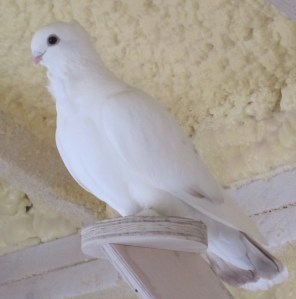
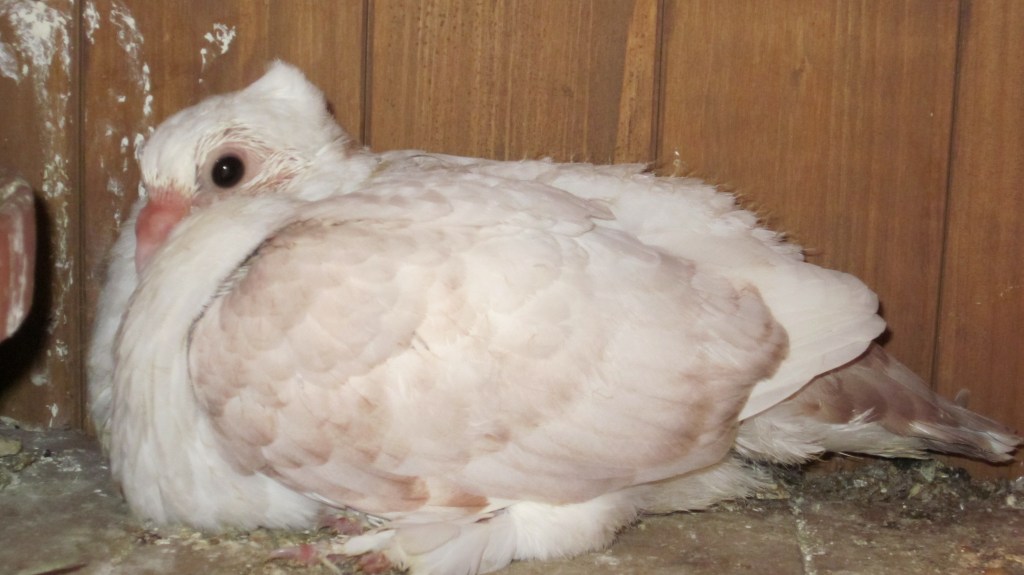
This young hen is nearly done with the transformation to pure white. See the recessive red in the tail and a few of the secondary wing feathers? That will soon be gone and replaced with white.

This seven-month-old hen is nearly done with the transformation to pure white. See the recessive red in the tail and a few of the secondary wing feathers? That will soon be gone and replaced with white. It is not a show fault for a young bird to have some remaining recessive red or yellow feathers their first year.

“STATION: (15 points): Head held high, tail touching or nearly touching the ground. Elegant, with a clean, uninterrupted line from the shoulder to the tip of the tail. Graceful with flights resting on the tail. Shoulders are concave and the wing butts are held out separate from the chest and clearly delineated. FAULTS: Refusal to station. The presence of “sails.”  SERIOUS FAULTS: A duck-like stance with an elevated tail and arched back. Flights consistently carried below the tail. A short, stocky body with rounded shoulders.”

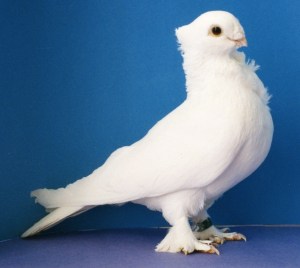
A particularly beautiful young Seraph cock.

A particularly beautiful young Seraph cock in show stance with no visible faults from this angle. There is no stockiness to this bird – he is long and svelte. His station – or show stance – is perfect according to the criteria above under “Station.” Seraphim should be judged when stationing. This one has a perfect station that shows off all of his attributes. His frill is amazing – full and gigantic.

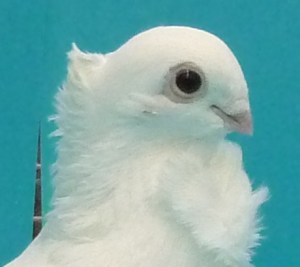
“HEAD: (25 points): Graceful, rounded over the top of the skull, having a concave dip (swoop) between the top of the head and the tip of the peak. The back of the skull is visible, and the tip of the peak is below the top of the skull. The desired “Apple” head results from adequate head height and a somewhat rounded skull. The light pink beak protrudes slightly beyond the frontal, but the setting of the beak is “downfaced;” the beak is small but strong and adequate to feed young. A medium gullet adds mass to the head; a visible gullet MUST be present. FAULTS: Flat head (lack of a swoop), peak too high or too low, weak or thin beak, angular head. Head too short from front to back because peak and mane are underdeveloped, so they do not stand far enough out from the back of the head. SERIOUS FAULTS: Skull too small so head is too small in proportion to body, egg shaped skull rather than round causing lack of skull height above the eye, skull too narrow, lack of skull height above the eye, pinched frontal, frontal too prominent, frontal too broad between the eyes (eyes should be visible when looking straight at the face.) DYSQUALIFYING FAULTS: Lack of a gullet. Beak too small.”This bird has the perfect skull shape.

“PEAK: (10 points): Needle point peak that stands well out from the back of the head and is separated from the head by a dip called the ‘swoop’. The tip of the peak is below the top of the head. FAULTS: Tufted peak, twisted peak, flat peak (partial shell crest), peak set too high or too low, lack of swoop (dip) between the peak and the head, peak set too close to the head.
EYE: (5 points): Bull (very dark). The cere is almost white. FAULTS: A faint light eye ring or faint light spots are minor faults. SERIOUS FAULTS: Pearl eye(s) and orange eye(s), eye cere any other color than almost white.”

#3. Look at the head on the bird above bred by Anya Ellis. Do you see that wonderful round arc from the tip of the beak up and over the eye, the exposed back skull, and finally the deep feather swoop curving upward to the peak point? THAT is the skull arc you want. This is what is called an “Apple Head” and is ideal for Show. The best have a measured width of top-skull between the eyes of 25-28 mm, with equal distance between the center of the eye and the tip of the beak. Let’s judge critically other characteristics of the bird shown, comparing it to the artist’s drawing in the 2017 Standard: The beak is satisfactory, but could be slightly thicker and shorter and slightly more downturned to more closely follow the arc of the skull; the eye is a perfect “bull” or black; a gullet is present but hard to see because the frill is so big (this is good!); the peak could be slightly higher and slightly farther back with less twist but definitely comes to a fine point; the frontal (forehead) could be slightly fuller; the top of the mane could be deeper, the head overall could be slightly larger, and the swoop could be a little deeper and more dramatic. Am I being nit-picky about this bird? YES. It’s a beautiful specimen that many would consider near perfect. The bird in the photo is stressed and it shows in the slight twist in the tuft of the peak. Let it relax a little and then come back and look again to get a more accurate sense of its feather ornamentation.

FRILL: (10 points): Thick (dense), heavily ruffled, wide, long, prominent, with feathers turned in many directions. (A zipper frill is not the ideal). FAULTS: Too little frill, wispy frill, frill too short or crooked, frill that turns only to one side. A zipper frill is not the ideal, but it is preferable to a thin, wispy frill, or a frill that turns to one side only.
NECK: (5 points): The neck is medium sized, not thick. It broadens as it flows from the head to the shoulders. A medium gullet is necessary as it adds volume to the head and dignity to the bird. (Owl breeds all have a gullet.) FAULTS: An overly long neck. A too large, overly pronounced gullet in a relaxed bird. DISQUALIFYING FAULT: Absence of a gullet.
MANE: (5 points): A well-developed mane should stand well out from the back of the head and flow smoothly from the tip of the peak to the shoulder in a convex, unbroken curve. The two sides of the mane should meet in a line down the back of the neck. The mane should appear symmetrical when viewed from the back. FAULTS: A break in the mane. Undeveloped mane that makes the head appear short from front to back. Mane not a continuous convex curve when viewed from the side. Disorganized feathers that do not meet in a straight line at the back of the mane. No visible meeting line where the two sides of the mane. Mane not symmetrical when viewed from the back.

bird059_1

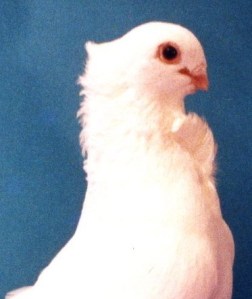
#4. Look at the bird at left. The frill is not quite as full and fluffy as possible, and a little short. It should extend from just above the wing butts to about a half inch below the beak. The neck on this bird is just right when standing tall, with a perfect concave curve at the back of the shoulder, but the gullet is a little weak. The mane is deep and stands out perfectly with a nice slight curve! Beautiful! The swoop is correct, but the peak is a little too low. The downturn of the beak and the arc of the skull are perfect. This bird has an ideal “Apple Head shape.” The Apple Head is the ideal for the Seraph if it is large and well balanced to the body – in this case it is properly formed but a bit too small. The eye cere (skin around the eye) looks a little irritated – too red. In spite of my criticisms this is a beautiful specimen! If paired with the bird below they might well create the perfect Seraph.

If I searchd and searchd for a fault in this Seraph I doubt I could find one.

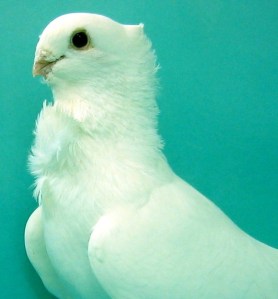
#5. Now look at this bird. What is different? The frill is a little longer and fuller, better than the frill of the above bird. The neck is perfect; the mane is astoundingly deep. The beak is down-turned; the arc of the skull is a little less round than it should be (not quite enough top-skull) but has a smooth arc. (The oval shape of the skull in this bird is the 2009 Standard.) The size of the head is fantastic (this is called a “bully” head – big and more egg-shaped than the “Apple” head.) The gullet is obvious. The swoop should be deeper. The peak is a perfect point and just below the top of the skull. Note how widely the wing butts are held from the chest – perfect! To my eye, this bird is significantly superior to the one above from the shoulders up even though I love them both. If the frill was even more full and the arc of the skull were rounder in the lower bird so that there was more distance between the top of the eye and the top of the skull, I would be unable to find a single criticism of this bird. One needs birds like this bottom one with the bully head in their breeding program to maintain optimal skull size as well as all the other superior traits this bird possesses. Paired with the Apple-Headed bird above some offspring might have the needed increased skull size to create a big Apple Head and a more perfect Seraph.

TAIL: (5 points): 12 feathers, slightly flared. Width 2.25 to 2.5 inches. Feathers aligned and touching each other, carried angled toward the ground. Tail should be long and touch or almost touch the ground. FAULTS: Tail too narrow (too well closed). Tail too open (fan shaped). Tail V-shaped or with twisted feathers. Tail held in an elevated position. Tail too short.
FOOT: (5 points): Each toe individually covered with tiny smooth feathers, giving the appearance of a glove with toenails protruding beyond the end. There should be a ‘sweep’ of ankle feathering that curves across the top of the foot at the ankle. These feathers should not be sparse, but they should not have the appearance of a muff. The glove feathers and the sweep feathers combine to give the foot the appearance of a white star.  FAULTS: Too much ankle feathering so that ‘sweep’ feathers appear to be a muff. Too little ankle feathering (sparse sweep feathers or no sweep feathers). Loose toe feathering, too much or too little toe feathering (exposed toes). SERIOUS FAULTS: A true muff is a serious fault.

The best time to photograph young birds is during the annual sorting. Photographs allow buyers of your Seraphim to have a clear vision of the quality of your birds.

The best time to photograph young birds and give vaccinations is during the annual sorting. This is a stunning specimen much like the one below. (See discussion to the right.)

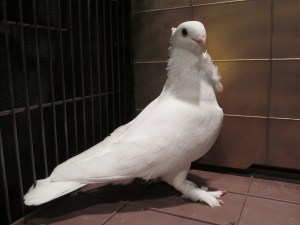
#6. Look at this bird to the left. The tail should be only slightly flared and just 2.5 inches wide, as in this case, and it should be long. The feet should be delicately feathered to the toenails like this. The sweep on the visible leg is being confined by the band on the leg. Though you can’t see the side profile of the neck and head, the body of this bird is perfect; tremendous length, wonderful line, concavity at the shoulders, wing butts held out, wings resting on the tail, fantastic big frill, great skull size. It is obviously in great condition and a great show bird. What you don’t see – but what I know – is that this bird also has a deep swoop and peak, and a rounder, slightly more arced skull than the bird shown above and below.

A Seraph cock out of the loft of Anya Ellis. This fine bird demonstrates the fine qualities of Seraphim created in a carefully planned breeding program. Outstanding features of this bird include the rounded skull, downturned beak, needle-point peak, very deep unbroken mane, wonderfully full chest frill, prominent wingbutts held out from the chest, long beautiful line, finely feathered legs and toes, and overall angelic aura. This is a very fine Seraph!

A Seraph cock out of the loft of Anya Ellis. This fine bird demonstrates the qualities of Seraphim created in a carefully planned breeding program. Outstanding features of this bird include the large skull, downturned beak, needle-point peak, very deep unbroken mane, wonderfully full chest frill, prominent wing butts held out from the chest, long beautiful line, finely feathered legs and toes, and overall angelic aura. This is a very fine Seraph!

#7. Compare this bird to the left – one you’ve already seen from the shoulders up – to the one just above. Both are nervous so slightly crouched but look at how similar they are! The bird at left though is carrying the tail feathers a little too flared and may have small “sails” on the upper side of the wings interfering with the smooth line of the back. A judge would have a hard time deciding which of these two birds is best, but the bird above would be judged slightly superior due to a rounder skull shape, absence of sails, and an ideal tail width. 

CONDITION: (5 points): Clean, white, smooth appearance, firm feel, solid chest muscles. FAULTS: Dirty, thin, poor feather quality, loose feathering, holes in the feathers.

David Coster, Manager, SCI


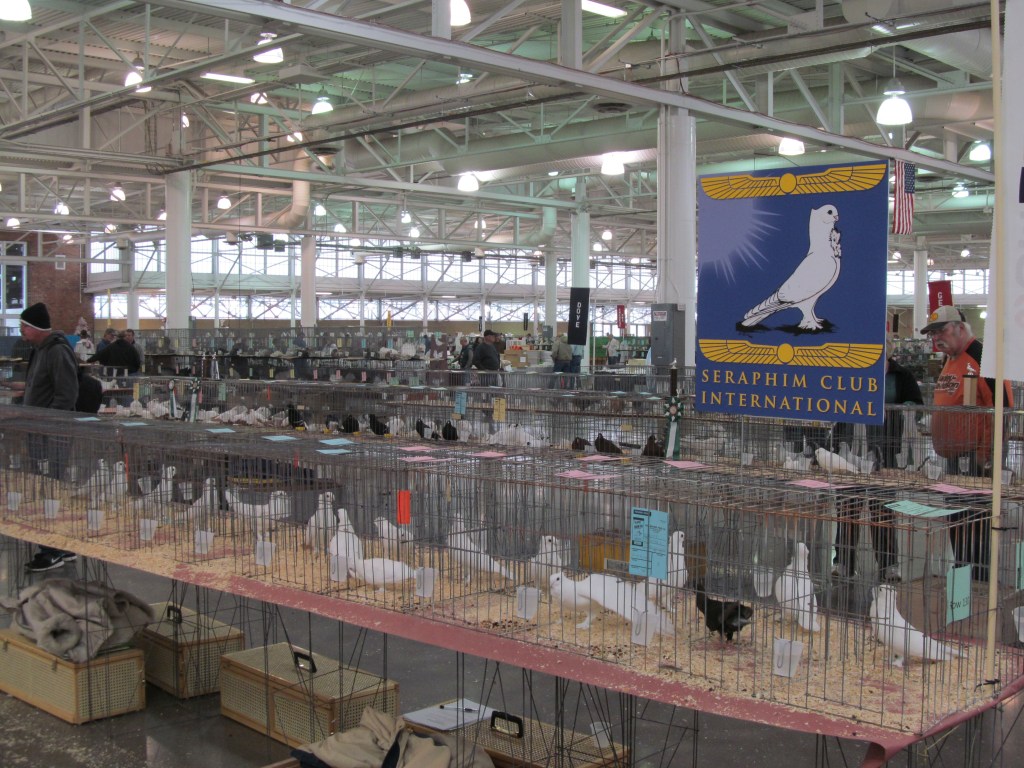
The Seraphim Club International at the Iowa State Pigeon Association 2012 Pigeon Show

The Seraphim section at the ISPA show, December 8th, 2012.

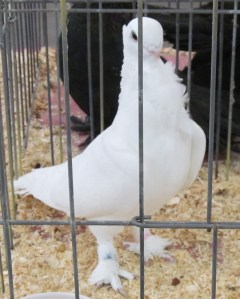
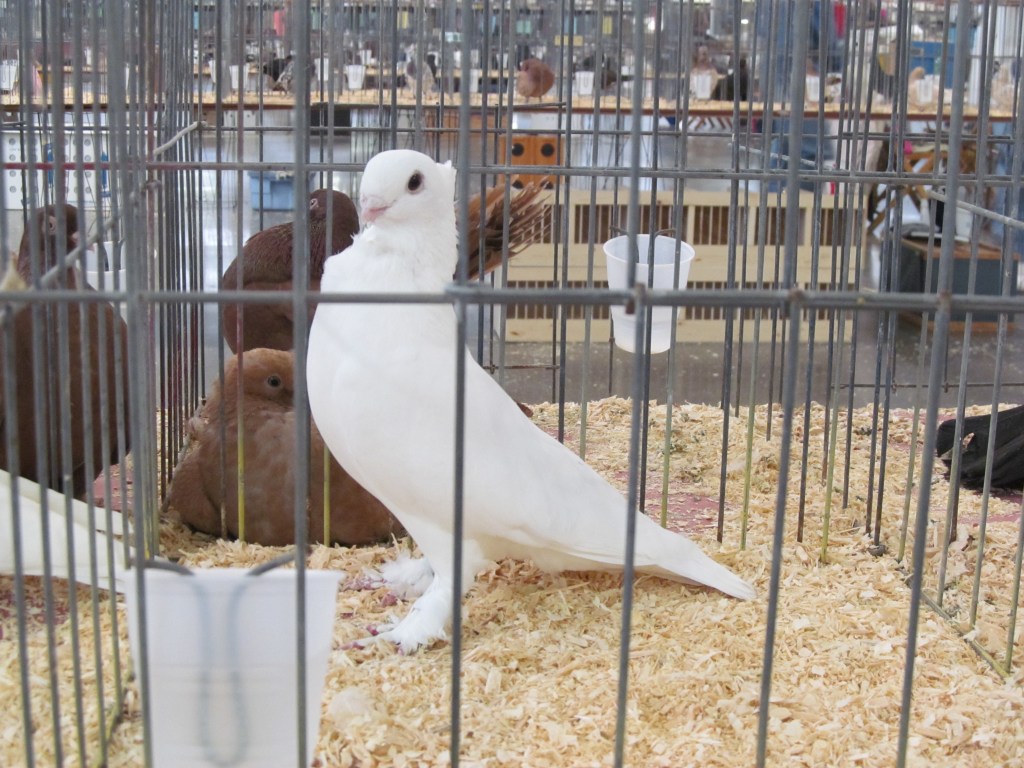
A Seraph in show stance at the Des Moines Show. There were over twenty Seraphim at the show this year.

A Seraph in show stance at the Des Moines Show. There were over twenty Seraphim at the show in 2012.

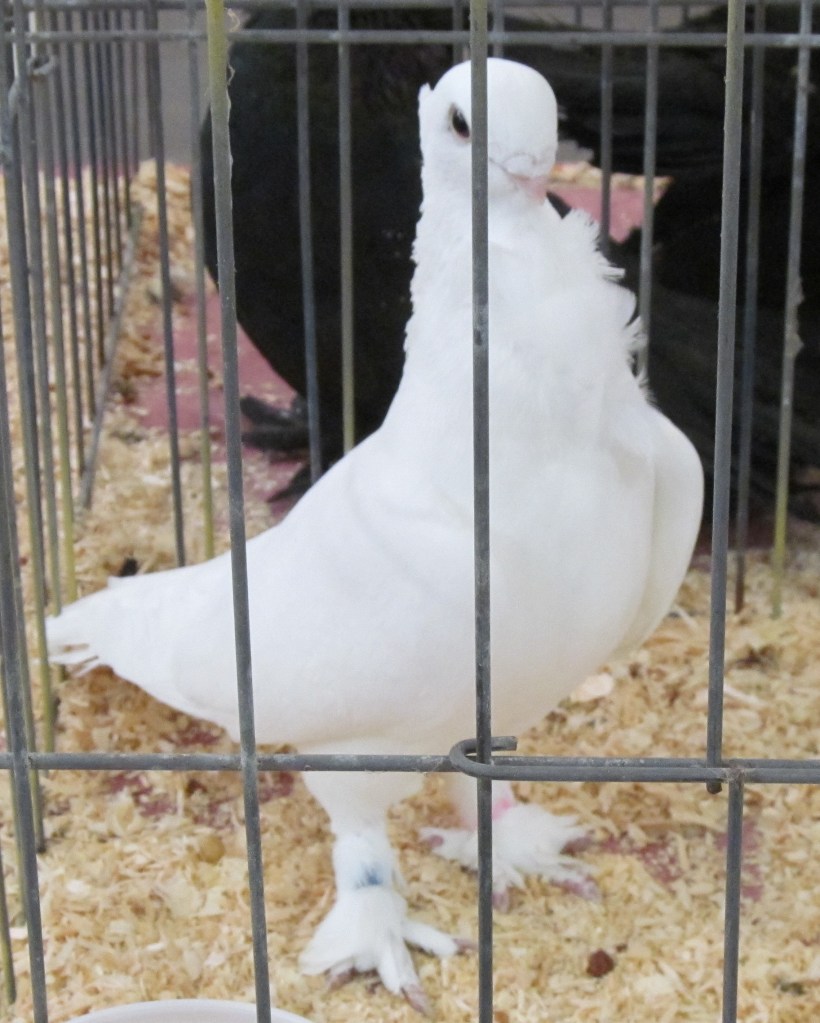
A particularly beautiful young Seraph cock.

A particularly beautiful young Seraph cock.

The Seraphim Club International made a formal showing in 2012 at the Des Moines “Pigeons on the Prairie” fancy pigeon show sponsored by the Iowa State Pigeon Association. The Seraphim had their own section in the Rare Breeds section and were judged by the Rare Breeds judges. Seraphim were present from Minnesota and Eastern and Western Iowa.

David Coster, Manager, SCI

Sorting Your Seraphim

The best time to photograph young birds is during the annual sorting. Photographs allow buyers of your Seraphim to have a clear vision of the quality of your birds.

Whether you breed your Seraphim year-round or establish a “season” for breeding, you will at some point need to stop and evaluate the result of your efforts. For your own sake, and that of your breeding birds, it is most advisable to designate a period of months for reproduction followed by a period of rest and evaluation. The period of rest is a great time to evaluate and finally sort your birds.

As you know by now, Seraphim and all other Fancy breeds have an annual molt at the end of the summer, generally beginning in late August in the Northern hemisphere and ending at the latest by mid-November. The winter period after the molt (October and on) is thus riddled with show schedules, culminating in the big national show in January, since the birds look their best during that period of time.

Because of the timing of the annual molt as well as the annual show schedules, most breeders will set up their mating pairs between January and March and terminate the breeding season by August. Your birds will never look better than they do for the few months after the molt, and will never look worse than they do during the breeding season attending to messy little babies day in and day out, so there is a definite method to this scheduling madness.

If there is a special annual show or two where you always like to attend and show your birds, it’s important to work around them with your breeding schedule so that your adults all look their best for the show and the annual young have had the chance to molt into adult plumage as well. It’s also important to keep in mind that feeding youngsters and molting simultaneously is pretty tough on the adults nutritionally. Either the parent or offspring can suffer from protein malnutrition under such circumstances, so additional protein in the diet will be needed, along with more fat and vitamins.

Most breeders split up the pairs at the end of the breeding season and separate the cocks and the hens. This forces the hens to stop laying eggs and makes it easier to re-pair with different mates the next year if desired. If you keep your pairs together year-round, removing the next boxes will minimize nesting attempts. If a pair goes to nest during the annual rest-period, replace the new eggs laid with wooden eggs. This will keep the pair occupied and prevent them from laying eggs immediately again after removal. Seraph hens have a limited number of egg follicles and by age seven will typically stop laying. Controlling the rate of egg laying can extend fertility. Starting breeding control just before the molt in August will allow them to hold on to that pure white magnificence you want for show purposes, and all the babies hatched before August will almost always be in top form for show by December at the height of the show season. Nearly all of the birds in your loft will be potentially show-able using this schedule.

The other thing such a schedule does for the loft manager is give them a break from the work intensity of the breeding schedule and an opportunity to study and thoroughly evaluate their birds. Obviously, every loft owner will manage their flock as they please since their birds can and will breed year around if given the chance, but it doesn’t hurt to maintain a reasonable and healthy schedule for all parties involved.

When it comes time for sorting the fruits of my labor each year, this is how I do it: I breed from a few pairs each year, and each pair is assigned a color to designate that family line. For instance, the SeaHorse line is pink, the James line is blue, etc. (I name my birds.) At banding time, each chick is given a numbered band on one leg and a colored family line band on the other. In this manner I can watch and study the offspring as they grow up, maintain a pedigree, and easily record changes that help me identify them later.

In mid-October I go out late one night with a flashlight and pick all the birds up and put them in travel carriers. The next morning, they are all placed in show cages, with the parents heading up their line of offspring for the year. The youngsters are divided by gender, and the most superior cock and hen in the line-up is moved ahead to the two cages nearest the parents; these will be part of my show team and/or kept for my own breeding program as long as they are at least High Standard quality. The rest are marked for sale or re-homing, even if they too are high quality and intended for show. I do the same thing with the next line, and the next until I have located the best cock and best hen from each line. If any birds are identified that have faults that make them useless as breeding pairs, those birds are marked for placement in a free flock that I keep out at the farm or give to people who want something pretty just to watch in an outdoor aviary. Some people euthanize birds that don’t advance the show-quality nature of their lofts – it’s a common practice in fact – but I find it to be terribly distasteful and always look for other options.

I then line up the best young cocks from all lines, and the best young hens from all lines. I again compare.  I then make the final decision about which will be kept for my breeding program, depending upon the family lines and how they should be interbred and whether or not there are birds present that can advance a particular characteristic in the flock that needs improvement. Finally, I decide how to make pairs from the young birds I’ve decided to keep based on their attributes and deficiencies; when the next breeding season arrives, the chosen pairs are placed together in small cages for a week or so until they are bonded.

Having now decided which birds you are keeping for your own loft and which you want for show competition, the “For Sale” birds are identified (the “for show” categories and “for sale” categories will always overlap, as will the “to keep” and “for show” categories) by band number in a ledger. Already you need to begin thinking about how to pair them to fill orders, taking into account the strengths and weaknesses of each bird. It’s important to know when filling orders whether the buyer is a serious breeder who will show birds, wants them for a backyard aviary, or will be flying them in a free flock. The most exceptional birds adhering to the Show Standard should be reserved for serious breeders. Poor quality birds should simply not be sold, unless they will be functioning in a non-breeding situation. Of the “For Sale” birds, you should always pair family lines that are compatible genetically and will likely result in exceptional or outstanding offspring, and the good qualities of one bird or family line should offset any less than superior qualities in the other bird or family line.

Ultimately, this sorting process will also answer another necessary question: Are you producing top-quality birds with your current mated pairs? If you discover that the birds from one line are all inferior to the others, you must decide whether or not to continue that line, split the parents and pair them with different mates, or completely take those parents out of the breeding program. Sorting in the manner described can help answer that question and assure that you are constantly improving quality from year to year.

Finally, it’s important to keep and maintain your foundation birds. As the years go by you will rotate your older birds out of the breeding schedule to some degree. Nevertheless, if you have exceptional older birds that are the genetic foundation for your entire program, birds from which you can retrieve qualities that might be lost due to unexpected complications from breeding younger birds, you will always be okay.

David Coster

The Story of Seraphim

By David D. Coster
The story of Seraphim started as an unexpected event. To tell the tale, we have to go clear back to 1986 and the original tiny loft of Anne (Anya) Ellis near Milan, Illinois, USA. That year, Anne could best be described as a novice pigeon keeper who had been searching for specimens of the beautiful Classic (old-fashioned) Oriental Frill pigeon. Knowing little of Fancy Pigeon breeds, the National Pigeon Association, pigeon competitions, and the whole world of pigeon breeding and pigeon fanciers, she had started out years previously with a wild pigeon, then graduated to a few homers, and finally ended up with Classic Oriental Frills one day after seeing one perched on the loft of her friend Art Grammens.
The breed was no longer common, having largely been replaced by the larger, short-beaked Modern Oriental Frills in the mid 1900’s. Over time, as she gradually collected more specimens, Anne studied the colors and patterns displayed in her flock and began to learn everything she could about them and their color genetics. One color she never found in her search for new Classic Old Frills was red, a color she really admired in Modenas, so she went about trying to find a way to get a beautiful red in her little flock of Classic Old Frills.
Determined that she was more likely to get the red she wanted with a little help, she took some of her Classic Old Frills over to Bob Pettit for a color genetics consultation. Out of that bunch, he identified one that he was certain was carrying a recessive red gene and told Anne to use that bird to get started in her effort to create a red Satinette Classic Oriental Frill. She paired the blue bronze-bar cock Bob had identified as carrying recessive red with a brown t-pattern toy stencil hen. Incredibly, the hen was also carrying recessive red unseen, and the first two babies were both recessive red. The odds for such a stroke of luck were low, and yet it happened. Unfortunately, the cock died while the babies were young, but the hen went on and raised them alone, another stroke of luck.
Over time it became clear that the red in the two youngsters was not the beautiful “improved” recessive red Anne had seen before in Modenas. The babies had dull reddish-brown feathers in a Satinette pattern.  As the first molt began, brighter red feathers did not appear either. Instead, white feathers began to replace all the red ones. This was not what she had expected. The experiment to create red Satinettes had seemingly failed. She had to find another way. The two failed birds were placed with the rest of the flock, and she stopped paying attention to them.
One morning a couple of months later she went out early to the loft just as the sun was peeping into the window where the two little disappointments had been perched for the night. Both were sitting in a beam of sunlight. All the red was gone; the two young birds were pure white. The light reflection cast a halo around them. “Angels!” she thought. She had paid so little attention to them the previous two months that she had not seen until that moment that the two youngsters had molted into the purest, dazzling, entirely white adults one could imagine. She stared some more. “They look like Seraphim,” she thought. And that’s how the “White Angel of the Pigeon Fancy” first appeared, and that’s how they were named.

This is B1, the first known bird with Seraph color genes in existence. All Seraphim trace their ancestry back to him and his brother, W1.

Anne captured the brothers and raced over to Bob Pettit. “Look what happened!” she exclaimed. “It’s something new!”  She wondered if this could be the start of something. Maybe whatever happened to cause this could be replicated. Maybe this could be the beginning of the color project she had been looking for, or maybe she could even create a new breed.
Bob pointed out that the cause or source of the mutation(s) that had turned the two birds white was not known. Anne had to dig deep into science and history now to figure it out. Bob patiently explained that the scientific process to create a new breed was an arduous one, but she wanted to see what she could do with these two unusual birds.
And so, she began. She paired a sliver hen with one Seraph cock (B1), and then backcrossed the first generation (F1) back to B1. This resulted in the transmission of the recessive red genes and the unknown genes that turned the birds white in 50% of the offspring, all of which were cocks. A brown Satinette F1 hen out of the “B1” line was paired to B1’s brother, W1 – the other original Seraph cock, which finally resulted in the first Seraph hen in 1988. A Seraph hen didn’t appear in the “B1 Line” until 1991 – thus, Anne had to keep pairing the over-abundant Seraph cocks from the B1 line with “split” hens – F-1 birds that carried half the Seraph color genes, whatever those were – to get the Seraphim project off the ground. The “split” (heterozygous) F-1 birds were named “AIM birds” by Anne’s friend, Ralph Marerro, because they were, he joked, “aiming to be Seraphim.” Her best AIM birds were her “Seraphim in disguise” until she produced that first Seraph hen in 1988, finally allowing her to pair Seraph to Seraph and paving the way to fast track the process of establishing the new breed, her ultimate goal.
Over the next seven years the breed was imagined and defined by careful selective breeding using both the B-1 and W-1 lines. Little by little she refined what the Seraph was supposed to look like. The feathers gradually lengthened, giving the birds bigger frills, longer flights and tails, and a frillier ornate appearance. Likewise, the physical form was gradually shifted to become more svelte, with concave shoulders, a narrower chest, and a more upright posture. It was an effort to create a work of art, a living sculpture, through both selective breeding for structure and selective breeding for color genetics. Meanwhile, she began attending to the needed breeding experiments to determine the color genetics behind the transformation to white in her Seraphim. Historically there were reports dating back to the 1940’s in America of recessive red Modern Oriental Frill pigeons gradually becoming paler and paler over repeated molts until they became almost white, but they always had a trace of pale red remaining. This was called “the red problem” back then. No one had an improved red in Moderns even though they tried and tried. They always faded. There is no historical evidence for, or any written record of, a successful recessive red in Classic Old Frills in the United States either (until just recently – see The Magic of Seraphim Genetics). The breed fell out of favor with the introduction of the Moderns, and Classic specimens became very difficult to find by the 1960’s. No one wanted them, and no one was working on color.
Bob Pettit helped Anne, searching far and wide for old-style (1930’s era) Old Oriental Frills with the characteristics she needed to achieve the creation she envisioned, and then introduced her to Doc Hollander, who designed a breeding experiment using self-recessive red wild-type pigeons to understand the color genetics involved with Seraphim. Dr. Hollander worried that Anne had too little space in her loft to do the necessary breeding trials to sort out the color genetics of Seraphim, so he engaged Tim Kvidera to take some of Anne’s Seraphim to his large loft in Minnesota to perform breeding experiments. Here he determined that the recessive red gene in Seraphim was linked with the “White-Sides Gene.” The source of the tail whitening genes could not be determined but they seemed to be linked to both the Recessive Red and the White-Sides Genes in some way. The White-Sides and Tail-Whitening mutations could be split apart in these experiments though with intergenerational and generational crosses, producing visual rose wing, white sides, red tails, white tails and various red patterns on the head, neck and chest, as well as Seraphim. The experiments required many generations and backcrosses, so the answers came in slowly as the work of refining the breed in Anne’s loft continued. Although the wing and tail color changes could be split out, it appears that there was likely some linkage and perhaps some other factor that was causing the color change to be an immediate one when it occurred, rather than gradual.
By January 1995, nine years after B1 and W1 first appeared, Anne had met the National Pigeon Association requirements of showing five Seraph cocks and five Seraph hens at three consecutive Grand National Shows. She had written the first show standard for Seraphim and had given a presentation to the Board of Trustees on the new breed. Her work and that of her friends and associates paid off, and Seraphim were officially recognized as a new breed by the National Pigeon Association.
In December of 1995, Anne met Jean-Louis Frindel at the German National Show in Nuremburg, Germany. Jean-Louis, of Lalaye-Charbes, France, is the artist who paints the pigeon standards for the German and European Standard books. He was taken by the beauty of Seraphim and decided that France should be the first European country to officially recognize them. As hoped, The French National Pigeon Association (SNC) was the first in Europe to recognize Seraphim in 1997. Arrangements were made for a story about Seraphim in the French pigeon magazine, Colombiculture, with Anne featured on the cover holding one of her prize Seraphim. The story was a hit, opening doors for articles on Seraphim in other European pigeon magazines. Anne spoke about her experience at the Centennial National Show in Chambery in 2003 and in a European film about Fancy Pigeons. The most memorable connection created by the article was with Gabriel Thomas of France, who fell in love with Seraphim and wrote Anne hoping to acquire some to help him recover from a personal life tragedy. It took two years to finally get birds into his hands in the Brussels airport and it was a big moment for both Anne and Gabriel. Through him, Jean-Pierre Demuyter and Rene Dautel (a French judge) joined the Seraphim Project.
Contributions to the development and promotion of the Seraph breed were made by many others, including Terry Fick, Everet Uhls, Raul Delgado, George Simon, Gottfried Ernst, and David Coster. Anne is indebted to all who advised and assisted along the way.
Today the Seraph Show Standard has been firmly established, with the newest Standard announced in 2017. (See under Show Standard in the side bar on this site.) The color genetics have also been worked out to a finer degree (See under “Genetics” in the side bar.) The discovery of “controller genes” and “gene switches” have allowed for a better understanding of how pigment production is turned off in Seraphim to create a pure white bird. Finally, new information from Professor Axel Sell in Germany has hinted at a probable ancestral genetic connection of Seraphim to a rare color variety of Uzbek Tumblers called Tschinnies which may explain their color change.  (See under Genetics in the side bar on this site).
Anne’s work for the Seraphim Project had the unexpected side effect of renewing interest in Classic Oriental Frills across the United States. She became highly expert in their color genetics and introduced the breed to many fanciers while working on Seraphim. With her support, the Old-Fashioned Oriental Frill Club was established in 2003 by friends of Anne – Harold Collett and others – and today Classic Oriental Frills are one of the most popular breeds in the United States. (See Club History at the Classic Oriental Frill website at http://www.classicoldfrill.org.)

David Coster, Manager, SCI

Photographs of Seraphim Pigeons

Those of you with a penchant for photography and taking photos of your Seraphim can send your best photo-shots of your birds to me at cozmd@aol.com. I will be happy to add them to the photo series. 

A beautiful pair of older Seraphim. The cock on the left demonstrates all of the favorable characteristics of a quality show bird. He has what Anya Ellis likes to call “the skull” – the wonderful large, rounded head with a nice down-turned beak.  He also has a nice swoop and point, nice frill, stance, chest, wings, length, feathering – a beautiful bird and a show winner. His mate demonstrates what one can call the “refined” features of the hen, another beautiful bird with the same style as her mate, but frankly – feminine – and elegant.

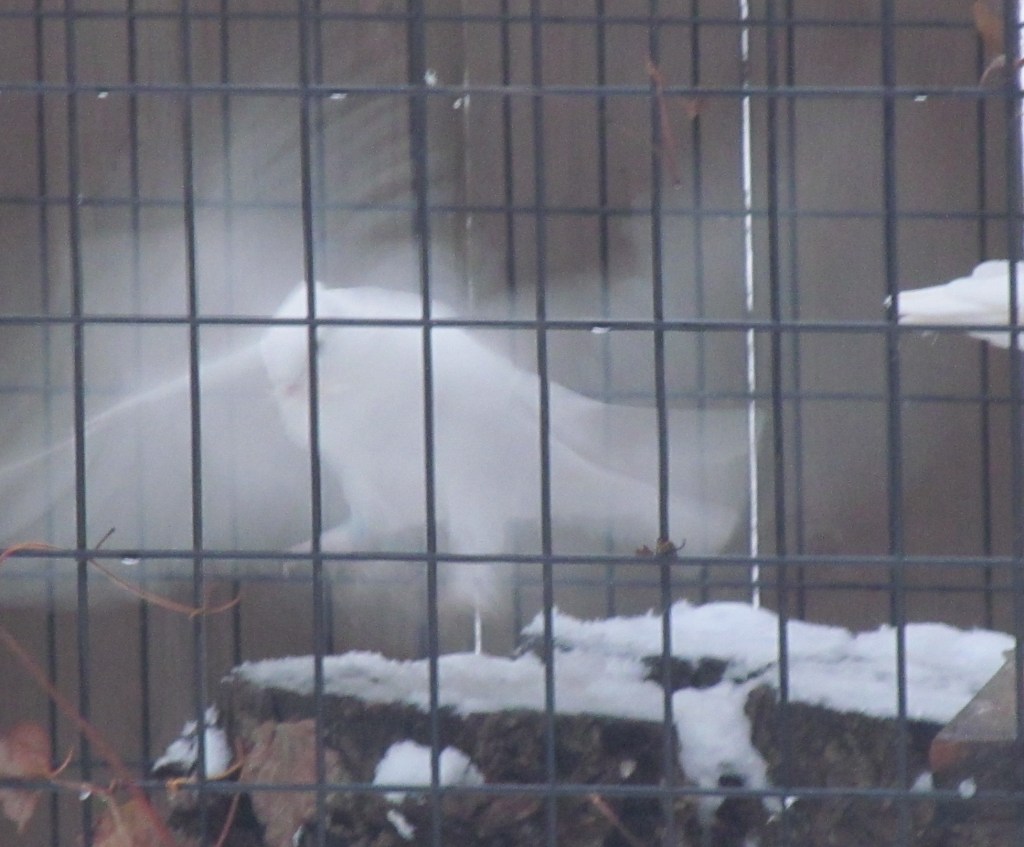
Seraphim love the snow and get very rambunctious when out in it! This Seraph has just had a bath and took a moment to flap wildly out of pure ecstasy. It’s a ghostly and lovely image and demonstrates the power of those long white wings. Notice he is just as white as the snow!

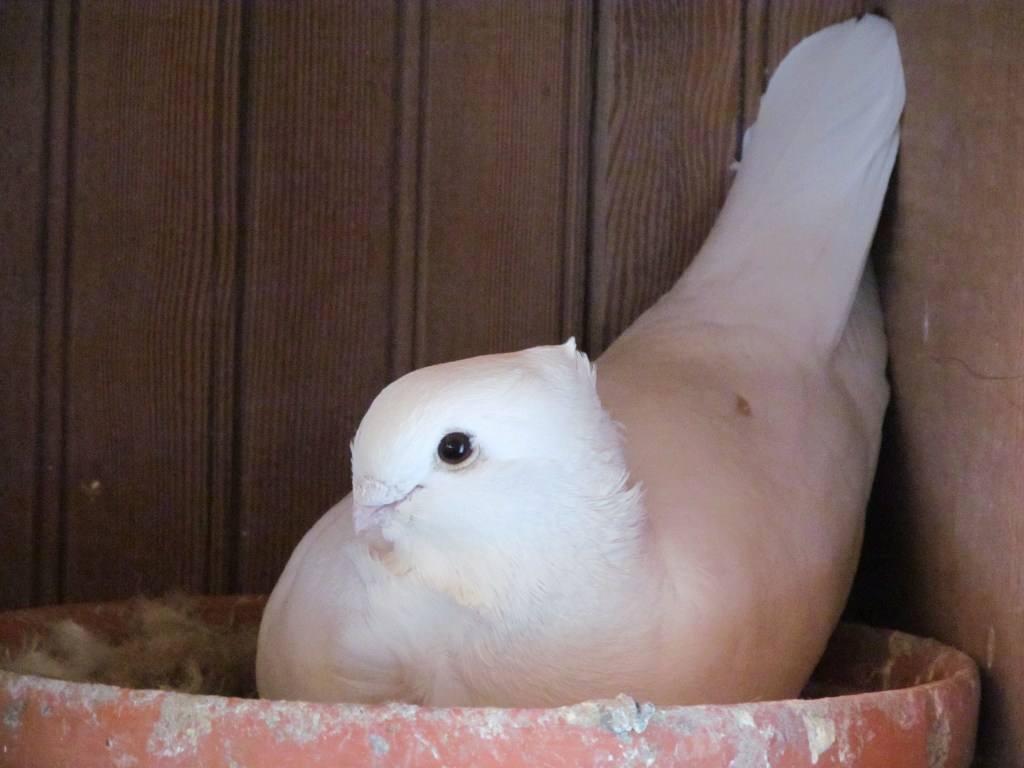
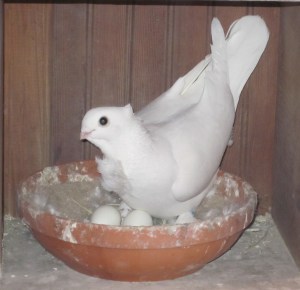
A Seraph cock attending to daytime incubation duties. He is in a Belgian clay nest bowl – just the right size for Seraphim. When relaxed like this, the “swoop” behind the skull often flattens out to a large degree, as is shown here. This is a beautiful specimen. 

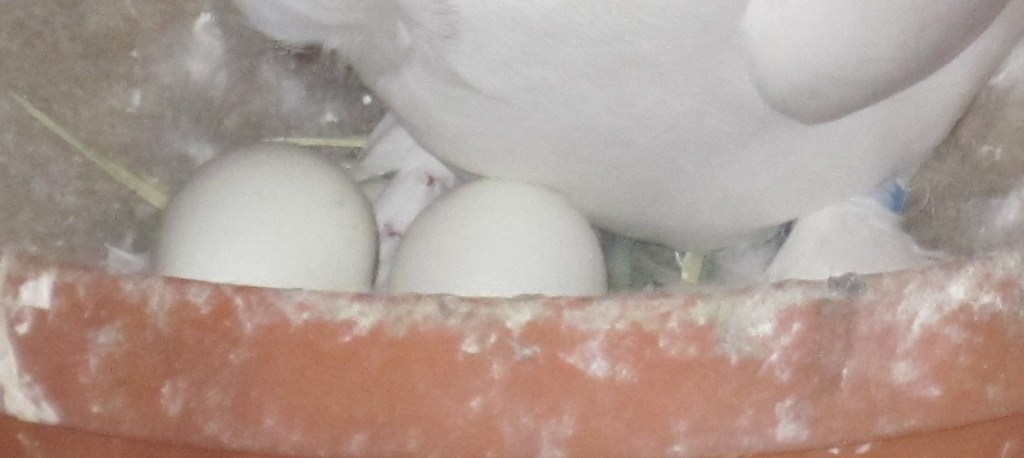
In eighteen days, there will be two little squeakers in this nest.

Hideous little critter, isn’t it. About ten days old and in pinfeathers. If anyone doubts that birds are dinosaurs….

Well, THAT’s certainly better! Too fat to walk and too young to fly at 3 weeks. But definitely cuter. Note how diffuse and pale the recessive red color is in this youngster’s wing-shield. This fellow grew up to be a show winner. 

This young hen is nearly done with the transformation to pure white. See the recessive red in the tail and a few of the secondary wing feathers? Those are her baby feathers. They will soon be gone and replaced with longer white feathers.

Just another day hanging out in the loft, doing our thing. 🙂

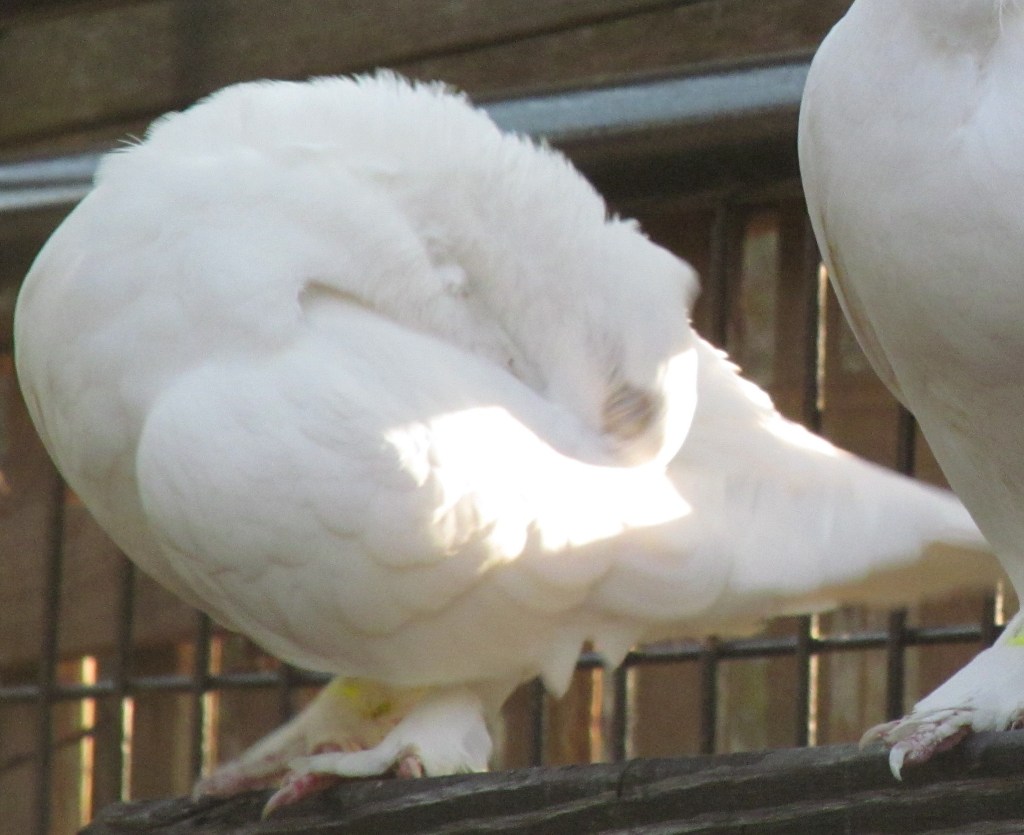
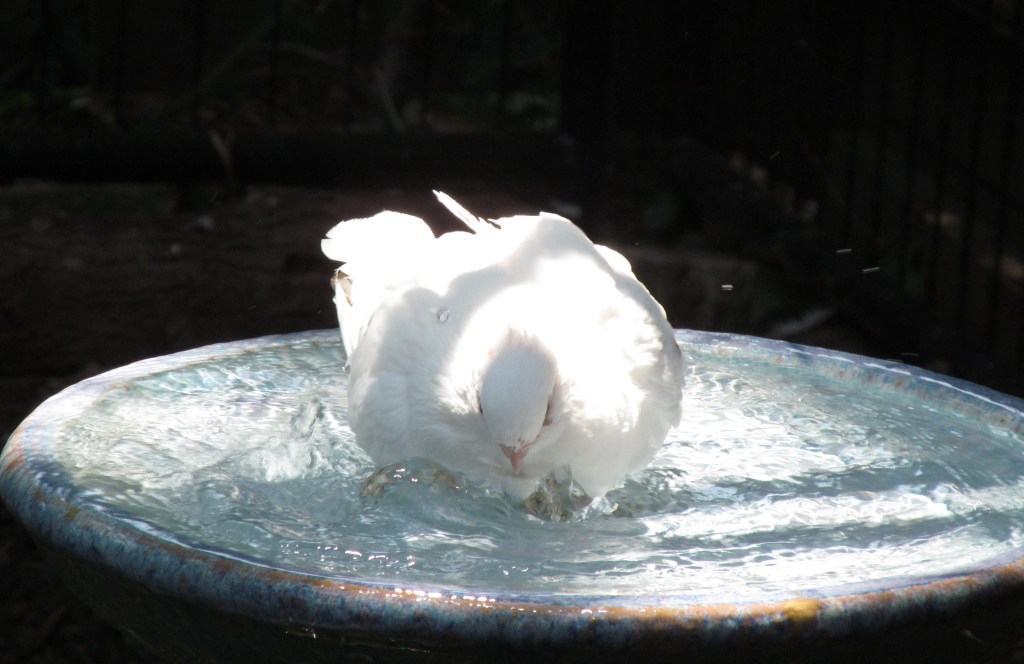
A luxurious few moments of feather work in the afternoon sun…

A young Seraph enjoying a blue fountain.

Posing for the camera…

A late Fall afternoon…

The most beautiful Seraph...

The most beautiful Seraph. This bird, Seahorse, lived to be twelve years old. 

The Magic of Seraphim Genetics – A Deeper Dive for the Serious Breeder

Let’s take a deeper look at what makes Seraphim so unusual genetically, this thing that causes them to transform from a red Satinette color pattern to a pigment free, pure dazzling white – and how does this differ from the white of other pigeons in pattern of inheritance? And what else is going on genetically in Seraphim that makes these Fancy Pigeons different than their breed of origin, the Classic (Old) Oriental Frill? If you are unfamiliar with basic pigeon color genetics you can skip down in this same article to the section called Basic Pigeon Color Genetics and review it before diving into the explanation that begins immediately below. I’ve made this as simple as I can, but the color genetics of Seraphim is a bit complicated.

SERAPHIM COLOR GENETICS:

Let’s start with definitions and descriptions of what we know at this point based upon the known history of the origin of the breed and the color breeding experiments done to confirm its color inheritance. The “Seraphim Color Gene Complex” is a combination of color genes that is unique to Seraphim. The complex is made up of background genes that affect color distribution along with a combination of gene mutations that cause the Seraph to turn white at the first molt. All of these color genes and gene mutations are required for color in Seraphim.

BASE COLOR GENES in SERAPHIM:

SATINETTE PIEBALD:  The first two birds that demonstrated the Seraphim Color Gene Complex were hatched from a pair of Satinette Classic Oriental Frills. The first genetic color requirement in Seraphim is presumed to be the basic Satinette pattern of color distribution, a pattern that was created over time using the Piebald mutation(s) and the Dominant White Flight mutation. Below is a photo that shows the Satinette distribution of color and pattern in a Classic Oriental Frill:

download

You will note that the Satinette Oriental Frill is white except for the wing shields (the small shoulder feathers overlying the long flight feathers), the tail feathers, and the tail covert feathers (small feathers overlying the base of the tail). The white in the head, neck, chest, body, feet, and legs comes from Piebald genes. The areas of white have been relatively fixed in place by generations of selective breeding but can only be maintained by careful attention to detail, as Piebald is a “fuzzy” trait, i.e. it doesn’t breed true consistently, so it’s difficult to get a perfectly marked Satinette; often there will be a stray, colored feather in the field of white. The Piebald white color distribution over the body makes the Satinette Classic Oriental Frill look like it’s wearing a tuxedo. 

DOMINANT WHITE FLIGHT: The ten long flight feathers are also white in Satinettes, and this comes from a gene called “Dominant White Flight.” (See above photo.)

IN SUMMARY: The white areas in Satinettes come from the gene mutations of Piebald and Dominant White Flight. The colored areas seen in Satinettes are always one of the basic sex-linked colors that all pigeons carry, such as blue/black, ash red, or brown. (The bird shown above is blue/black.) The color pattern (feather markings) may be stencil, barred, T-check, spread, or any other pattern. The Satinette color distribution over the body is the underlying basic color distribution in all Seraphim, but it is always hidden (masked) in the adult Seraph because of three additional color changing mutations.

COLOR CHANGING MUTATIONS:

The three additional color mutations in the Seraphim Color Gene Complex are overlaid on the Satinette color distribution. These are unimproved “Recessive Red,” “White-Sides,” and an as yet undefined “Tail-Whitening” mutation.

RECESSIVE RED: Recessive Red is a non-dominant autosomal color gene that turns all of the colored areas on a pigeon red when it is inherited from both parents. The red hides and covers all other color genes the bird may have.

WHITE-SIDES: The White-Sides mutation, when inherited from both parents along with Recessive Red, will cause red pigment in the wing shield to disappear with successive molts, gradually turning the shield white. The mutation is probably a genetic “switch” that turns off the production of red pigment feather by feather. 

TAIL-WHITENING: TheTail-Whitening” mutation has not been sorted out, but it is also probably a genetic “switch” rather than a gene. When inherited from both parents, it turns the tail white with successive molts.

In the case of Seraphim, the Recessive Red gene is initially turned to “on” to produce pigment in a Satinette distribution, but then turned to “off” by the White-Sides and Tail-Whitening gene switches to create the absence of pigment in the wing shield and tail of the adult. So, the baby Seraph always starts life with the Satinette color pattern in Recessive Red.

A strange thing happens, however, with this combination of genetic mutations in Seraphim. Rather than gradually losing red pigment with successive molts, the birds lose ALL red pigment with the FIRST molt. Linkage of the White-Sides and Tail-Whitening genes and gene switch mutations may play a role in this unusual transition from red to white.

**Interestingly, in Seraphim, juveniles which have mismarked red pigmented feathers in areas that are supposed to be white based on the Satinette Piebald color distribution, still molt completely to white, suggesting that the “controllers” that stop pigment production in the wing-shields and tail are also having a broader effect on the whole body, head, and neck. It thus may be that the Satinette color distribution – presumed to be essential – might not actually be essential for a Seraph to turn pure white. (There may be another explanation. See “Important Note” a few paragraphs below.)

MORE DETAILS ABOUT RECESSIVE RED MUTATION: The Recessive Red mutation is a recessive gene on one of the regular (autosomal) chromosomes which, when transmitted from each parent, overrides or masks the primary Ash Red, Blue, and Brown sex-linked color genes that normally determine the basic color of all pigeons. It usually masks feather pigment patterns as well, with exceptions. Birds with a pair of these recessive genes will appear “red,” while birds with only one of these genes will show the color carried by their sex chromosomes – Ash Red, Blue, or Brown. Recessive Red is epigenetic to all other colors except Recessive White and albino, i.e., it hides or “paints over” (dominates) them so they are not seen. However, Recessive Red does not “paint over” white piebald areas or stencil patterns. Recessive Red Satinette birds will thus appear red in the wing shields and tail regardless of the underlying sex-linked color of the bird, and they will show a spread, barred, or lacewing pattern and a lace tail or spot-tail pattern. The “Dilute” gene will modify the red color to yellow if present. Since all Seraphim are Satinette as a base color pattern as well as homozygous for Recessive Red or Yellow, they appear at first feather to be marked as Red (or Yellow) Satinettes. Seraphim babies are never white.

MORE DETAILS ON THE WHITE-SIDES MUTATION: The “White-Sides” mutation is fully expressed ONLY in birds homozygous for both it and Recessive Red or Yellow (Dilute Recessive Red), and it is probably not a gene, but rather a gene controller or switch that links to the Recessive Red gene.  Pigeons of any color or type may carry the White-Sides trait invisibly, but if a Recessive Red pigeon inherits one copy of the White-Sides mutation, its wing-shield will turn partially white or “rose” with the first adult molt and that pattern will remain; if it carries two copies (one from each parent) the wing shield will turn completely white with successive molts.  

MORE DETAILS ON THE TAIL-WHITENING MUTATION: The “Tail-Whitening” mutation is a separate mutation that causes the tail to stop producing pigment and turn white with successive molts. The mutation probably affects a genetic controller switch that sends a signal to the pigment production gene to flip to “off.” In experimental crosses of Seraphim with pure Recessive Red pigeons, crosses of the F1 and F2 generations result in birds with a mix of rose, red, and White-Sides in the shield with either red or white tails, proving that the White-Sides and Tail-Whitening traits can be split out from each other. It is clear then that the gene controllers for turning on the White-Sides and the Tail Whitening mutations are different. In Seraphim, however, the whitening effects of the two mutations are switched on together all at once early in life rather than being expressed over multiple successive molts, but why? More on that below:

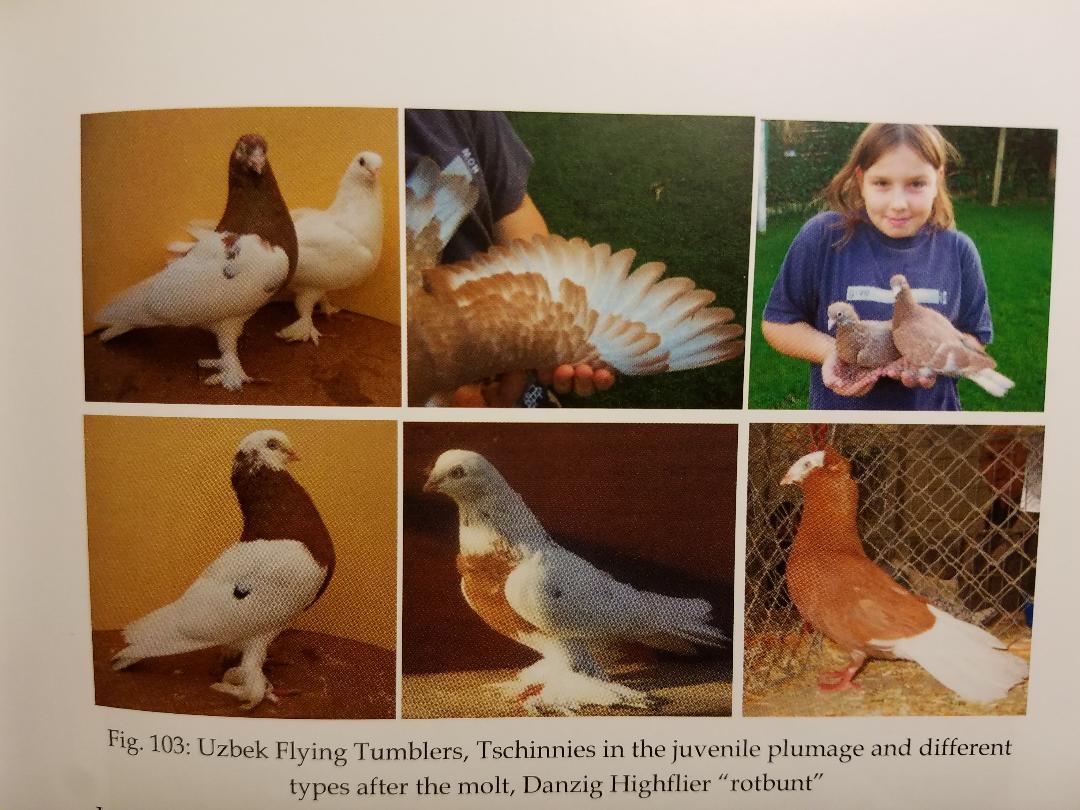
**IMPORTANT NOTE: There is a color variety of Uzbek Tumbler called a “Tschinnie” that is native to the Ottoman area (modern day Turkey etc.) that is Recessive Red and molts to either pure white or various beautiful predictable patterns of red and white with the first molt. The Krasnodar Tumbler is another. There is a description of Tschinnies in Axel Sell’s book “Pigeon Genetics,” pp. 130-132. In personal email conversation with Dr. Sell he acknowledges that the genetic similarities between Seraphim and Tschinnies cannot be ignored, as they both are Recessive Red with the Tail-Whitening and White-Sides trait, and the Oriental Frill and Uzbek Tumbler breeds arose in the same area of the world. 
20181021_075001

The Tschinnie colored Uzbek Tumbler may be the ancestral source of the recessive red and all of the whitening genes that exist in Seraphim today. In test crosses performed in 2006 by Andreas Leif on the Redhead/Neck variety, the Redhead/Neck trait was found to be allelic to White-Sides; Leif also suspected that a dominant enabler (switch) was required for expression of both the Whitesides and Redhead/Neck trait. (Photo from Axel Sell, “Pigeon Genetics,” page 131.

According to Mr. Sell there is anecdotal evidence that the Tschinnie color gene combination was deliberately crossed into Classic Oriental Frills, probably in the 1800’s. If this is true, then no matter how small the possibility, those linked Tschinnie genes were still floating around in the genetic pool of existing Classic Oriental Frills in the U.S., or Seraphim would not exist today. It could be predicted that Anne Ellis’s effort to make a Recessive Red Satinette Old-Fashioned Oriental Frill in 1986 using only the few existing Old-Fashioned Oriental Frills in the U.S. had a tiny chance to throw those Tschinnie color genes back together again. The Classic Oriental Frill had been essentially abandoned in the United States at that time and the breed was not recognized by the NPA, so the population was small. Everyone was breeding Modern Oriental Frills instead. Anne’s Recessive Red project caused her to seek high and low for Old-Fashioned Oriental Frills (as they were called then) and bring them to her loft because she needed to find the recessive red gene – if it existed in the population – and she needed genetic variability. She became distracted from her Recessive Red project by the Seraphim Project, however, when two babies with the Seraph Color Gene Complex appeared in her very first experimental nest meant to make a recessive red Satinette. (See the article on this site on The History of Seraphim.) She spent the next 30+ years working on refining the Seraphim breed instead of pursuing improved recessive red Satinette Classic Oriental Frills.  Others became interested in the Old-Fashioned Classic Oriental Frill again because of Anne’s Seraphim Project, and Anne sold many of her Satinettes to other interested breeders including Harold Collett, who later established what is now the Classic Oriental Frill Club in 2003. Anne’s Seraphim project thus set the wheels in motion that both created Seraphim AND re-established the Classic Oriental Frill breed, which has today become so popular in the U.S. A Recessive Red Satinette, however, was not ever created by Ms. Ellis and could not be created from within the existing population of Classic Oriental Frills because a pure Recessive Red did not already exist within the population. Recessive Red DID exist in Moderns in the 1900’s, but the color was poor and impossible to maintain; it always faded with successive molts, leaving only a trace of pale red. Eventually an improved Recessive Red was bred into the existing Modern Oriental Frill population, solving their “Fading Red Problem.” Improved Recessive Red Classic Oriental Frills, however, were not created in the U.S. until just recently.  Mike McLin succeeded in making high quality Recessive Red Classic Oriental Frills by using an outcross to a high – quality improved Recessive Red Modern Oriental Frill and aggressively culling the offspring. (“Making it More Interesting” by Mike McLin, Purebred Pigeon Magazine, March/April 2020, pp. 56-57.) Others may have had success using out-crosses as well but simply not published about it.  Today improved Recessive Red is recognized in the Classic Oriental Frill in both Satinettes and Blondinettes. All of this historical information is important both for Seraphim fanciers and Classic Oriental Frill fanciers.

A very important recent development is a project in Turkey to recreate all the ancient color varieties of Classic Oriental Frills – “Hunkari” in Turkish. One such variety is called “Manisa Azmani.” They are pure white with colored tails, but one color strain is completely white. The project to re-establish all of the ancient color varieties of Classic Oriental Frills is headed up by Turker Savas and championed by Serkan Gunduz of Salihli, Turkey. Below is a photo of a Manisa Azmani, white with a colored tail. We do not have this color variety in the United States. Note that the structure of the Manisa Azmani below is that of the Show Standard for a very high quality Classic Oriental Frill.

OIP

Below is a diagram of all the color types of Manisa Azmani, summarized by Serkan Gunduz. Note that they include both smooth head and peaks. The smooth head style is not included in the United States Standard for Classic Oriental Frills in any color. Also note the pure white Manisa Azmani in the top row, second from the left. The drawing looks very much like the Show Standard for Seraphim. I have never seen a pure white Manisa Azmani, but it could be very difficult to distinguish from a Seraph. The color genetics are different, however, as the white Manisa Azmani is pure white from the beginning (conversation with Serkan), whereas the Seraph is red-marked at first, and then molts to pure white.

427741553_122130432512114406_1290972444844848035_n

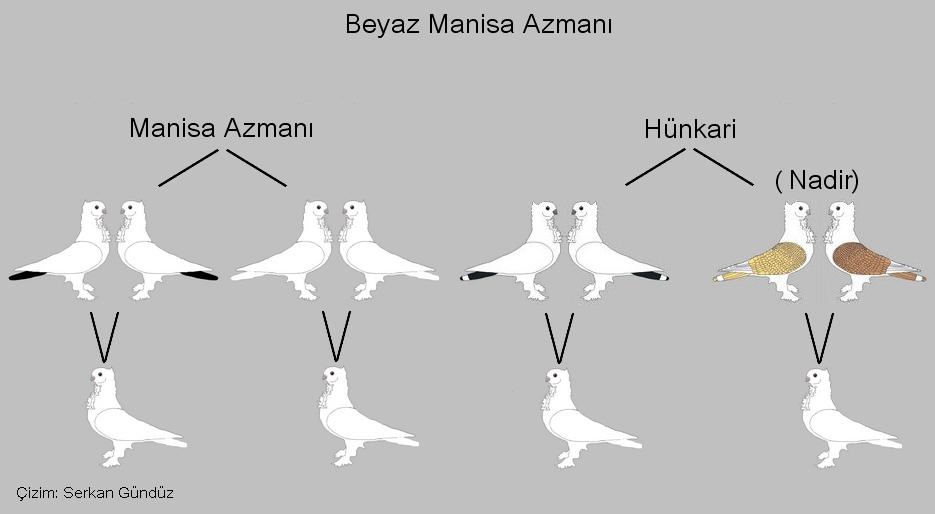
Here below is a diagram showing the various parental combinations of Manisa Azmani and Hunkari that are known to produce pure white youngsters. White paired to white always produces white. I do not know how often a white baby appears in the case of the other pairings. Serkan tells me that due to the popularity of all the other colors of Classic Oriental Frills in Turkey, white fell out of favor and became hard to find.
424965873_7289450021122622_7932124183185295637_n

Below is a baby Seraph, red and white in the Satinette (Kanat) pattern. In comparison, the baby white Manisa Asmani or Hunkari would be completely white at this stage. 
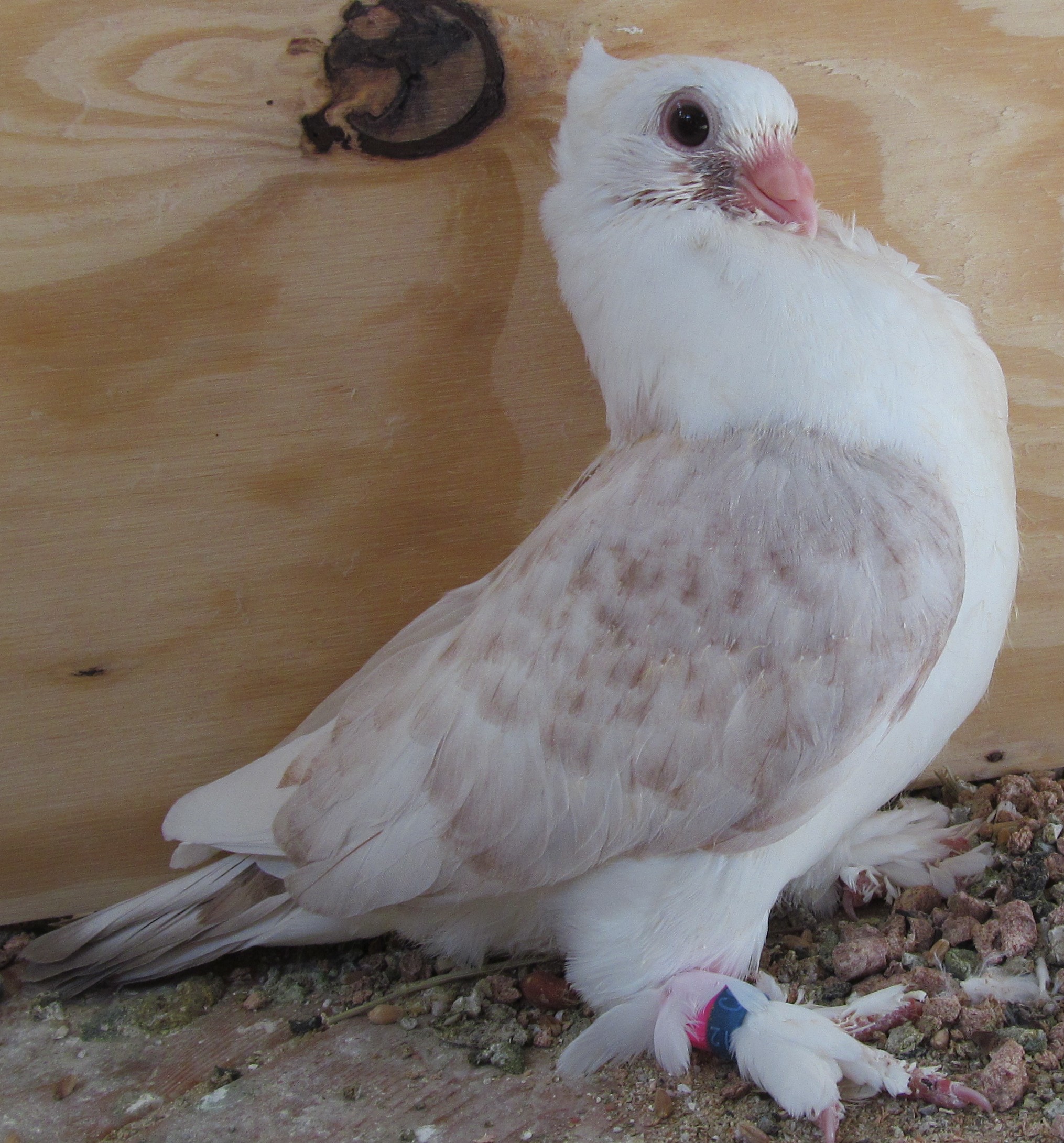
First baby out of NoBand and Snow. 2012. One month old.

Adult Seraph, below. Aside from structural differences, it would be nearly impossible to distinguish this adult Seraph from an adult white Manisa Azmani unless you have a good eye and raised them yourself and confirmed the color of the birds as juveniles. The structural differences for Seraphim are due to decades of selective breeding to create a bird with a more vertical stance and a longer visual line. (See The Importance of Selective Breeding a few paragraphs below.) 

Casper at the 2014 National

Below is another diagram by Serkan Gunduz showing most of the known color varieties and patterns of Hunkari (Classic Oriental Frill). There are even more ancestral color variations within each category than are depicted here. The Turkish team working on recreating these colors (and more) tells me that they have seen a couple Manisa Azmani with recessive red that fades gradually with successive molts without ever going completely white, which seems to be the same “fading red problem” that was such an issue here in the United States in the 1900’s. They have not seen anything that behaves like the Seraphim Color Gene Complex in Classic Oriental Frills there. I think the work that Turken and Serkan and their colleagues are doing to recreate and organize all of these categories of color genetics is very important and should be studied very carefully by the American Classic Oriental Frill Club.
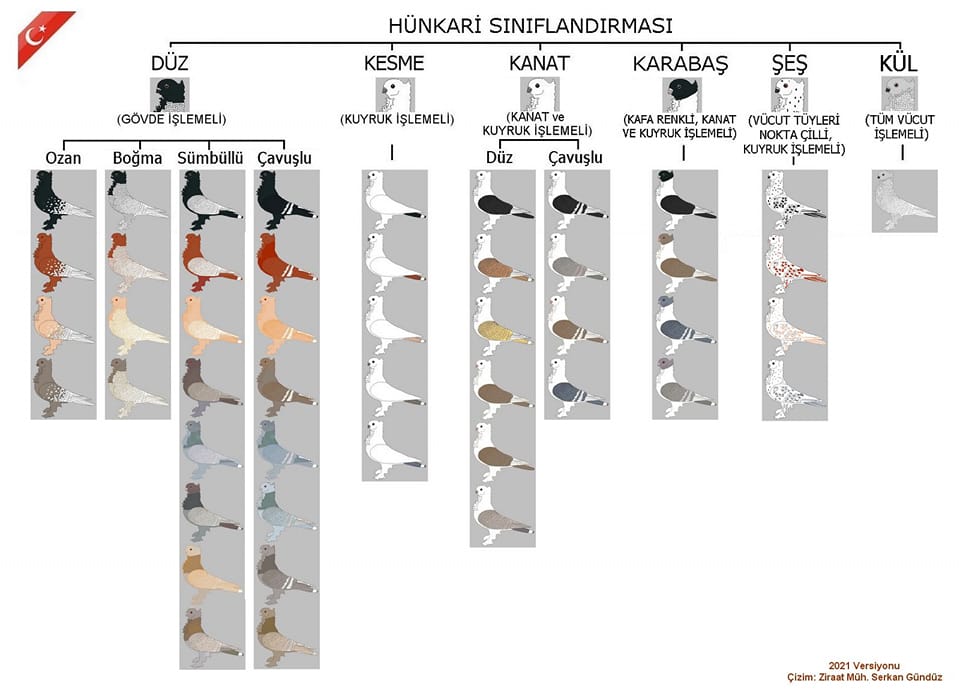
336922426_6355627627823315_2870138338375596703_n

The purpose of the above discussion on color is to explain the color genetics of Seraphim and to convincingly demonstrate that Seraphim have a specific set of color gene mutations that are not known or seen today in the ancestral Classic Oriental Frill population in Asia Minor (Turkey and the surrounding regions), and particularly in the white Classic Oriental Frills found there. My research has led me to believe that the Tschinnie Uzbek Tumbler, used as an outcross for color two hundred years ago or more, is probably the source of the genetic mutations that cause Seraphim to turn white with the first molt. In particular, I think it was the red head/neck variety of Tschinnie; the breeding tests by Tim Kvidera in the 1990’s on Seraphim outcrossed to pure recessive red produced a variety of color patterns confirming the role of the White Sides and Tail Whitening mutations, but one color combination that kept showing up was a white bird with red in the head, neck, or chest. (Conversation with Anne Ellis; See The Story of Seraphim for details.) Seraphim color and structure genetics cannot be understood without understanding the history of color and structure in Classic Oriental Frills and the Tschinnie Uzbek Tumbler. 

SUMMARY:

Going forward, for the sake of simplicity, we’re going to think about the Seraphim Color Gene Complex as a combination of genes inherited together as if they are a single entity rather than multiple genes and gene switches. It makes it easier to think about breeding them if one understands that although the Seraphim Color Gene Complex is many genes, mutations, and modifiers, it will always come through as if it were a single recessive gene as long as Seraphim are bred only to each other.

So, to review. Recessive Red, White-Sides, and the Tail-Whitening mutation were inadvertently recombined and overlaid on Satinette (Piebald, Dominant White Flight) in 1986 in two offspring of a pair of Classic Oriental Frills in the loft of Anne Ellis, creating the first two “Seraphim.” Though this was something new – a recessive red Satinette Classic Oriental Frill that molted to white with the first molt – the color changing mutations probably came from something old, the Tschinnie Uzbek Tumblers of at least two hundred years ago, and the mutations may somehow be linked to cause the abrupt transition to white. Anne went on to spend decades creating the new breed – Seraphim – from those two original birds, using selective breeding to gradually morph them into what they are today. (See The 2017 Show Standard for details. See below for more information on selective breeding.)

The visual conversion from recessive red Satinette pattern to pure white is the result of the expression of the Seraphim Color Gene Complex –  Satinette Piebald, Dominant White Flight, Recessive Red, the White-Sides mutation, and the Tail-Whitening mutation. This color mutation combination is an absolute defining trait for Seraphim. 

THE IMPORTANCE OF SELECTIVE BREEDING:

In order to create a new breed, separate from the ancestral breed of origin, the Classic Oriental Frill, a vigorous program was begun by Anne Ellis in 1986 to create a bird with the Seraphim Color Gene Complex that is structurally substantially different than the Classic Oriental Frill. Genetics come into play here, but it is much more difficult to change structure than add color mutations, as structure is affected by more subtle genetic variability and influenced by the environment, nutrition, and epigenetics. It takes a careful eye and a long time to change structure. Anne imagined what she wanted Seraphim to look like and then selected the traits she needed from existing Classic Oriental Frills. Once the traits were obtained, selective breeding was continued within the new population of Seraphim to reinforce and refine the desired traits, making the Seraph what it is today, nearly forty years later.
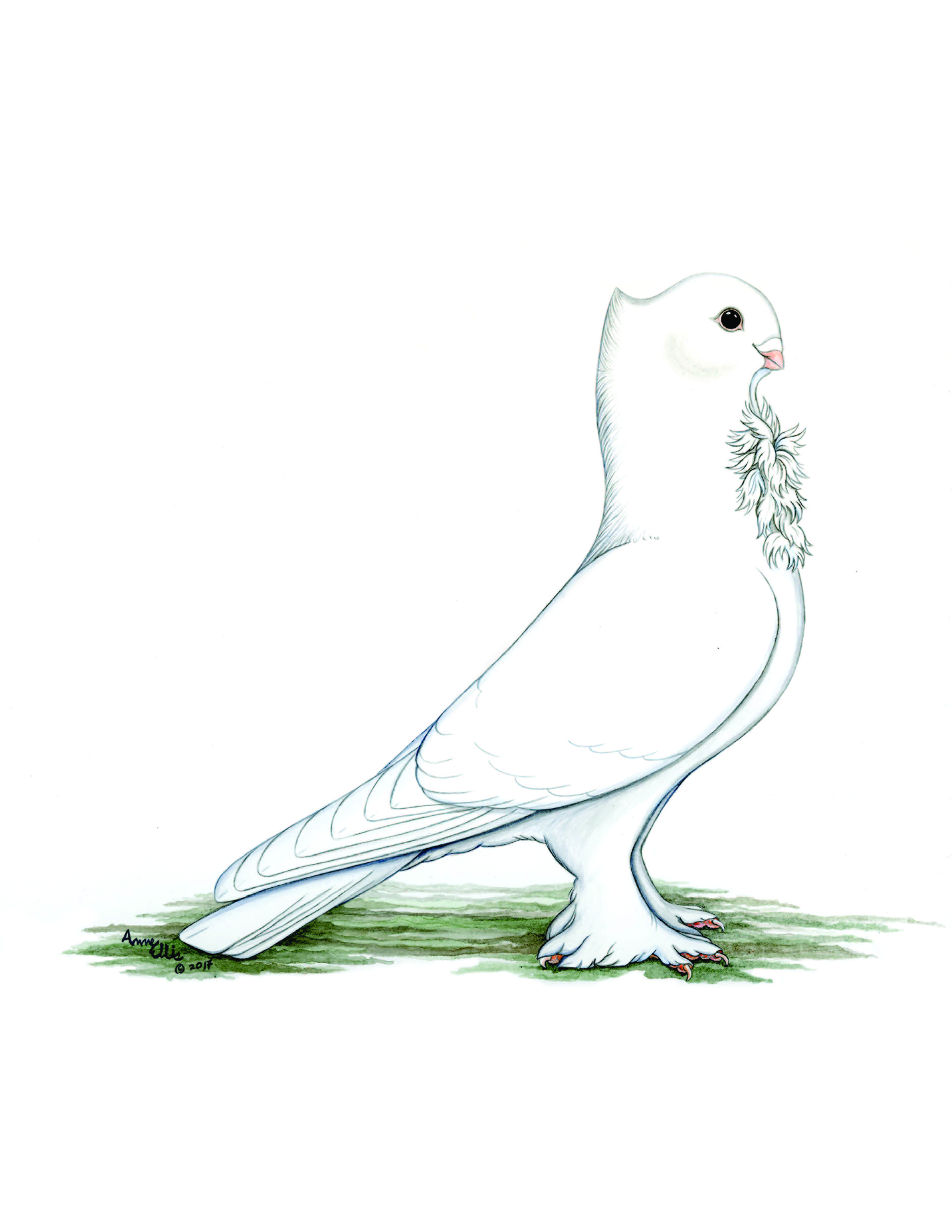
scan1Seraphimver3

Selective breeding for decades has given Seraphim an unusually beautiful, long flowing line. A narrower frame, a smooth concavity across the shoulders, increased height, a taller stance, and a rounded and larger head give it a look that is distinctly different from is breed of origin. Close attention to feather quality increased the overall feather length and frilliness. The toe feathers are longer, more refined and delicate; the swoop and mane are deeper; the needlepoint peak has been moved down below the top of the head; the frill is larger and fuller, and the tail and primary flights are long, adding to the long slender line of the bird. Their line makes them look fast and aerodynamic.  They also appear more androgenous; it is difficult to tell the sexes apart by size or general appearance, as their masculine and feminine traits have been deliberately balanced to make each bird a showy piece of art regardless of sex. All of the structural changes are easy to see when comparing the 2017 Show Standard for Seraphim (above) to today’s Show Standard for the Classic Oriental Frill (See image below.) Since 1986 the structural differences between the two breeds have become increasingly evident as both have been modified by different goals of selective breeding. The Seraph is a breed that stands on its own. 

imgres

Some argue that Seraphim are “just white Classic Old Frills.” This is a false argument I want to address head-on. Seraphim are a breed developed from the Classic Old Frill, but they are not “just” white Classic Old Frills. Seraphim have their own specific color genetics, and the Show Standards for the two breeds are completely different due to different goals in selective breeding for structure over the past forty years, as explained above. This should be obvious with even a cursory look at the images of the Standards for the two breeds. To actually find a true white Classic Oriental Frill that adheres to the Classic Oriental Frill Show Standard one would have to travel to Turkey, the only place I know where such birds exist today as Manisa Asmani. There are no white Classic Oriental Frills in the United States, and white is not a recognized color in the United States for Classic Oriental Frills. We can agree that Seraphim come from a limited genetic pool of ancestral Classic Oriental Frills and have the same basic genetic makeup, but we cannot agree that Seraphim are “just” white Classic Oriental Frills. Such a viewpoint completely ignores both the unique color genes and the nearly forty years of selective breeding done to create a bird that is distinctly different in appearance than the Classic Oriental Frill. After all, every breed that exists today has been developed from an already existing breed or a combination of existing breeds through careful selective breeding. Color is only part of the picture. One would not argue that all breeds of Pouters are “just a Pouter,” or that all breeds of Modenas are “just a Modena,” or that a Chinese Owl is “just an Old German Owl,” or that an Archangel is “just a Field Pigeon” without completely belittling all the work done by the originators and developers of those breeds which are admired and cultivated today. Without selective breeding, ALL fancy pigeon breeds would die out or revert back to their ancestral type. Seraphim are no different. They were invented over time, like all the other breeds, for a specific reason, from an already existing ancient breed. Serious and respectful pigeon fanciers respect the work others have done for breed development and will always breed toward the Show Standard for their breed, with recognition and understanding of the ancestral foundation upon which they are working.

BASIC PIGEON COLOR GENETICS FOR THE BEGINNER

(Please note the links in this article to Wikipedia entries and other sources that can be helpful. This can all be very difficult even when stated as simply as possible! Yet some basic understanding of these principles is necessary for the breeder of any Fancy Pigeon. The National Pigeon Association website has in-depth articles on pigeon genetics for those who wish to immerse themselves.)

CHROMOSOMES: The pigeon has forty pairs of chromosomes (or eighty individual chromosomes). Unlike other cells in the body, the sperm and the egg each have just forty individual chromosomes, or half the total, thanks to a process called meiosis which occurs only in testes and ovaries. When fertilization occurs and the sperm penetrates the nucleus of the egg, each sperm chromosome finds it’s match in the egg nucleus and pairs up with it. The fertilized egg now has a complete complement of forty paired chromosomes, or eighty total chromosomes, a normal pigeon cell. That cell immediately begins to divide using a new process called mitosis in which all of the chromosomes are duplicated just before division so that each division results in two cells with the full complement of eighty chromosomes. A great deal is now known about how this initial cell becomes an embryo and then a fully developed chick, but the details are too complex to discuss here. Enormous textbooks are written on the subject, and every day massive dissertations as well! It is wonderfully complex and amazing.

Anyway. During meiosis the various genes on the individual chromosomes remain reasonably consistent, but variation exists in the proteins that make up the DNA in those genes. Every time a new egg or sperm is formed there is the possibility that its chromosomes carry tiny changes in the order, or sequence, of the DNA proteins in the various gene segments. It is this possibility for change (mutation) that results in genetic variability, or differences that may be seen in the fully formed organism.

“Dominant” genes are segments of DNA that always express themselves over any mutation of the same gene sitting on the opposite paired chromosome. For instance, if a mother donates a gene for blue eyes and a father donates a gene for brown eyes, the child will always have brown eyes; brown always dominates any other eye color. The blue gene is there, but it is not visually expressed; it is “hidden” and will only show up if given a chance to pair up with another blue gene in the next generation. That blue gene may be passed on for several generations before finally getting the chance to appear when matched up with another person also carrying at least one blue gene. The blue gene is thus “recessed,” – or hidden – a “recessive” gene. It may also be called a recessive “trait”, or “characteristic.” Recessive genes or traits become important only when both parents carry them, as therein lies the only possibility for them to be expressed or seen.

“Partial Dominant”, or “Dominant with Variable Penetrance” are terms used to describe genes that are always expressed – but to a variable degree – when present, depending upon the effect of other genetic conditions present. Feathered legs and feet are an example of this phenomenon. The gene that causes this is dominant to the bare leg gene, but the variability in the penetrance – or visual expression – of the gene can result in anything from enormous leg “muffs” to “slipper” feathers to “grouse” feathers to “stubble” and anything in-between, depending upon other gene modifiers present that add to, or subtract from, the degree to which feather growth on the feet or legs is allowed.

There is also something called linkage. Sometimes genes are locked together and are passed on as a group that cannot be broken apart by the process of cell division and meiosis. In such instances, these linked genes are always expressed together at the same time, so for all intents and purposes the combination acts as if it is a single gene in the way it is passed on or inherited. Linkage may be partially responsible for some of the way color is passed on in Seraphim.

So, let’s review. Now you understand that each parent bird passes on half of its set of chromosomes in the egg or sperm so that the new chick has a full set of chromosomes – half of them from each parent. You also understand that some dominate genes on chromosomes overpower or dominate weaker recessive genes at the same location on the opposite paired chromosome; the paired chromosomes may carry a recessive gene each, a dominant gene each, or a combo of recessive and dominant. As Dominant always wins, the only time you can see hidden recessive traits is when they are on both chromosomes in the pair, so the trait has to come from each parent to appear. Linked gene combinations transfer multiple traits to the offspring all at once, and always together, so for all intents and purposes linked genes are inherited as if they are a single gene or trait.

SPECIAL CHROMOSOMES: So, let’s go back to those forty pairs of chromosomes once again. One of those pairs has a very special function: it determines the sex of the bird. This pair has a special name: sex chromosomes. The other thirty-nine pairs of chromosomes are called autosomal chromosomes, and they program almost everything else in pigeon development with a few exceptions

In Pigeons the sex chromosomes are called Z and W. The hen is ZW and the cock is ZZ. So, the W sex chromosome is responsible for creating the female sex. The hen thus determines the sex of the chick through the egg. If she donates a Z, it will be a cock. If she donates a W, it will be a hen. By chance, half her eggs will carry a Z and half will carry a W; the eggs with W will produce hens. The cock can only contribute one of his two Z’s, since that’s all he has. In pigeons, the genes for the primary base color of the feathers – Ash Red, Brown, and Blue – are also located on the Z sex chromosome. Ash Red is dominate to Blue and Brown, Blue is only dominate to brown, and Brown is recessive to both Ash Red and Blue. This knowledge can be a useful tool. Since the hen has only one Z, a breeder KNOWS that she has just one basic color gene on her Z chromosome and can pass only that one color gene to ALL of her male offspring. Her color is also true – her appearance matches her one color-gene on her Z sex chromosome; if she is blue, she carries only blue, if she is ash red, she carries only ash red, if she is brown, she carries only brown; nothing is hidden from the eye. Her W does not carry a color gene, so her female offspring MUST have their base color determined by one of the two Z chromosomes from the cock, whichever one he contributes at fertilization. One can thus determine what colors the cock is carrying by the colors that are expressed in his female offspring. This is a general basic fact that can be helpful for all breeders.

I wish it were just that simple, but obviously there are other color-pigment and pattern altering genes present in pigeons or one wouldn’t see all of the different colors and patterns one sees at Fancy Pigeon Shows. Most of these color and pattern modifiers are located on the autosomal chromosomes (the 39 pairs of chromosomes that are not sex chromosomes) and a few on the single pair of sex chromosomes. No matter what color the pigeon appears to be, though, every pigeon has a base genetic color of ash-red, blue, or brown on the sex chromosomes, even if you can’t see it. The base colors can either be fully expressed, modified, or completely masked by color-modifying genes on the autosomal or sex chromosomes.

There are several books available on pigeon genetics that can be found on Amazon Books. Anyone breeding fancy pigeons seriously should be sure to avail themselves of such resources.
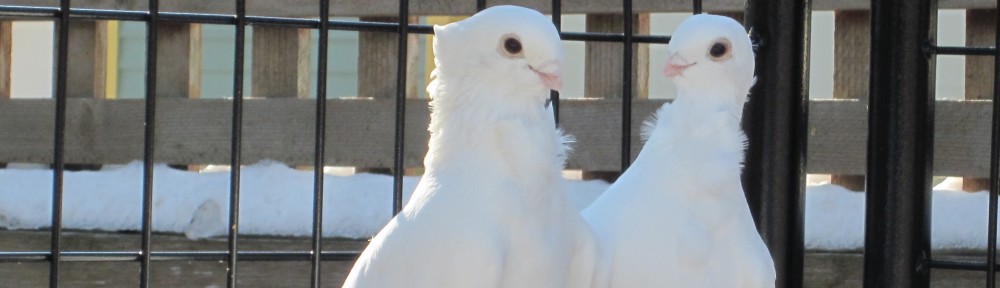


Breeding Seraphim Pigeons

THE BASIC PHILOSOPHY OF BREEDING SPECIALTY ANIMALS

A Seraph cock out of the loft of Anya Ellis. This fine bird demonstrates the exquisite qualities of Seraphim created in a carefully planned breeding program. Outstanding features of this bird include the strong skull, downturned beak, needle-point peak, very deep unbroken mane, wonderfully full chest frill, prominent wing-butts held out from the chest, long beautiful line, finely feathered legs and toes, and overall angelic aura. This is a near perfect Seraph from the 2009 Show Standard. 

If a choice is made to breed Seraphim, the fancier should always make every effort to breed from the best birds they have (or can get) and breed with a clear eye toward the Standard of the Breed. (Please refer to the article on The Show Standard.) This is true regardless of the purpose for maintaining ownership of Seraphim, and regardless of the number of Seraphim kept.

“Why?” you might ask. Good question. Let’s talk about it.

A visual of the modern Classic Oriental Frill Show Standard by Diane Jacky, as drawn for the National Classic Oriental Frill Club, Est 2003.

The only reason Seraphim exist is that an experienced Fancy Pigeon breeder noticed an unusual mutation in her loft and focused on it. Ten years of careful husbandry and genetic study finally led to the recognition of Seraphim as a separate breed or variety due to their particular combination of expressed genetic traits. Developed from the Old-Fashioned (Classic) Oriental Frill of the 1930’s type, Seraphim are substantially different in appearance and behavior from the Classic Oriental Frill of today due to the consolidation of their specific genetic traits by careful breeding. Like any designer domestic animal, Seraphim will vanish if their particular genetic characteristics are not kept and maintained within their gene pool. This is thanks to nearly forty years of painstaking work to refine and concentrate the genetic expression of their particular traits. In spite of the passage of so much time, the Seraph remains a Rare Breed. It is one of the newest recognized Fancy Pigeon varieties in existence and is not widely available. Thus, great care must be taken with the population in existence.

scan1Seraphimver3

The 2017 Seraphim Standard of Perfection as depicted in the NPA Book of Standards.

The message is simple. If you love the beauty of Seraphim, you simply must properly maintain the genetic pool to be able to continue to see and enjoy them. Otherwise they will vanish.

By definition, all Seraphim are related. None exist that did not originate from the original two males that hatched in 1986. The color genetics are set and well understood today, but the details that make the perfect Seraph structurally – like the enlarged skull, downturned pink beak, upright stance, curvy figure, long feathering, finely feathered toes, wing carriage, deep swoop and mane, huge frill, and personality are genetic traits inherited and expressed in more subtle ways that require constant care to maintain the breed. One must pay attention to all of these traits at once and carefully match up their birds to get babies that are as close as possible to the Show Standard. Always working toward that goal reinforces the inheritance and stabilization of genetic traits in the pool of breeding birds.

Breeding to The Show Standard can be very difficult, and sometimes it doesn’t work as expected. Seraphim are genetically complicated. How genes go together and are expressed can be very hard to predict. One must be prepared for failure as well as unexpected good luck. One must also be willing to experiment at times just to see what will happen if they try something new.

BEST METHOD FOR PAIRING YOUR SERAPHIM FOR BREEDING (To be read in conjunction with the article entitled “Sorting Your Seraphim.”)

The Purist Approach. This could also be called “Breeding Strictly to the Standard,” “Breeding to Win,” “Breeding for Show,” “Scientific Breeding,” “Pedigree Breeding,” or “Objective Breeding.”  It is a process of strictly pairing best to best or pairing to eliminate flaws and enhance perfection. This is the gold standard. For those who are emotionally attached to their birds it can seem unappealing. Seraphim will self-pair if given the chance, and Seraphim pairs act as if they are in love and are generally monogamous. Splitting them up and assigning them to a different mate for the purpose of creating Seraphim closer to the show standard may therefore seem cruel. However, they are highly adaptable and will typically mate with the assigned partner regardless. 

In an ideal loft, one has various rooms and compartments for their Seraphim. There is a room for Old Cocks, a room for Young Cocks, a room for Old Hens, a room for Young Hens, a room for Juveniles too young yet to be sexed, and one or more Breeding Rooms. After careful study and observation, the breeder will decide which birds he/she wants to cross each year in their attempt to create Seraphim that are as close as possible to the Standard. Those pairs will – usually in January or February, or early Spring if the loft is unheated – be taken to the Breeding Room where each pair will be temporarily locked into a breeding cage but separated by a see-through wire divider until their behavior indicates they have accepted each other and will bond to each other. The divider is removed, and once mating has occurred and eggs are laid, the breeding cage is opened so they can fly about in the Breeding Room and outside if there is an attached aviary. This technique assures precise parentage of the offspring, exact pedigrees (lineage of the young), and a relatively calm experience for the breeding parents. The breeder will soon see which pairs produce the finest specimens, and the next year the finest specimens will be used for the next breeding season. This approach constantly concentrates the best characteristics of the Seraphim flock. Many birds that are not used for the breeding program may be very fine specimens of show quality. Such birds often carry the necessary qualities to produce outstanding offspring and can be sent to other pigeon fanciers to work with. Such choices can be very difficult and might even prove to be wrong, but the advantage to a fancier looking for a pair or more of Seraphim is that the breeder with such a controlled program will choose the best birds from their non-breeders for sale, and with careful technique the new owner can expect to bring out the same superior show characteristics as the original breeder.

What if you don’t have space to separate your birds into categories in various pens as described above, yet you want to breed for Show and constantly improve your flock? “The Purist Approach can still be used in a single small room by using breeding cages for every pair for every round of breeding you allow. By carefully sorting your young birds every year (See the article on “Sorting Your Seraphim”) you can maintain your small flock for both show and breeding and personal enjoyment and provide high quality birds for other fanciers at the same time.

The main thing is to be thoughtful about controlling the breeding process. Even if you have no intention of showing your Seraphim, they should still be bred as if you do. Thus, the breed can constantly be improved and standardized. Don’t create lots of birds you don’t have room for or don’t know what to do with. You can control populations in various ways, such as limiting artificial light (Seraphim will cease laying eggs in the winter during short days), replacing eggs with faux wooden eggs and selling extra Seraphim, or giving them away to others who want some for their back yard dove cote.

THE BREEDING PROCESS: How it works, and what to expect.
Seraphim can successfully breed as early as eight months of age, though when starting so early they may have a couple of sterile clutches before finally having success. Most breeders would recommend waiting until 10 months of age to assure that maturation has been reached and one can expect a healthy reproductive cycle. Young cocks will generally declare their gender by four months of age when they become more aggressive and begin the classic courtship dance of pigeons everywhere, cooing loudly, standing very tall with neck feathers fluffed out, fanning their tail, and puffing up their crop. The hens, for their part, at about the same age may softly coo in response and even demonstrate a little dance themselves, bobbing their heads and lightly flicking their long flight feathers, puffing up, and fanning their tails; but their display is dramatically subdued compared to the male. It can be very difficult to determine the sex of young Seraphim up to even eight months, as both sexes will demonstrate some of the same behaviors up to that point and the cock’s cooing and dance may be a little pathetic until the full force of testosterone hits. Hens may even mount cocks at this age and seemingly go through the mating act while the cock allows it. This is why juveniles are, when possible, housed in separate quarters until it can be deduced who is whom. Adults are often very nearly the same size, so one cannot use size to determine the sex of the bird, except that the male head is usually larger and wider. Hens may become very impatient with other hens at maturity, pecking them and yanking out a feather or two and knocking them off the perches when given a chance, all of them vying for attention from the cocks.

A Seraph cock dancing in full courtship display.

A winning dance, apparently. The Seraph cock with daytime nest duties.

If you purchase a single pair, they may essentially be strangers to each other, and it will take a few days for them to settle into their new home. They will explore it carefully, as they are quite inquisitive little creatures. Very quickly they (almost always) will be bonded and be looking for a nest site, so if you intend to control the location of the breeding area in the loft, be prepared to place a nest bowl, box, or breeding cage within a week of the pair’s arrival, or they’ll pick their own spot someplace and begin building a nest on a secluded portion of a ledge. Also be sure there is plenty of grit and oyster shell calcium available at this time during the breeding cycle, and that you are using a high protein breeder mix for feed, at least 18% with added peas and safflower throughout the entire time period.

Seraphim, being a bit shy, prefer more privacy in their nest sites than some other breeds; a dark nest cavity that can be crept into is preferred, no larger than a 12-inch cube. Clay nest bowls can be obtained from Foy’s Supplies; they have air holes in the bottom to prevent condensation and are heavy so they can’t tip over. Add a coconut fiber pad to the bowl. As soon as the nest bowl is placed, the cock will fly over to inspect it and begin a dramatic display, calling the hen over to take a look. If she likes it, she’ll begin making low-pitched sounds, puff her feathers, and slink into the nest bowl on crouched feet, flicking her flight feathers. She may crawl right under the cock and remain there cuddled with him. The two of them will spend many hours cooing and billing while sitting there together. This will go on for a few days, and then the cock will begin loading up the nest with sticks and twigs while the hen stays put. She will spend longer and longer periods of time in the nest bowl.

About this time, you may notice some other behaviors. The cock will stay beside the hen closely, no matter what is going on in the loft. At feeding time, he will chase her around, pecking lightly but urgently at her back, barely letting her eat. He will aggressively chase any other suitors away from the hen. The hen will start taking more calcium.  The pair will begin to spend more time away from the prepared nest and the rest of the flock, seeking a space of solitude where they cannot be interrupted. They will find a secluded place on a ledge or in a corner on the floor. Here there will be a lot of billing and posturing. The cock will walk repeatedly around the hen. The hen may crouch intermittently, flicking her wing lightly on one side. At some point, the cock will stand tall, turn his head, and reach over his back and repeatedly comb one of his long primary flight feathers. This is the sign that mating is desired and about to occur. Critically, though, the hen has to respond with precisely the same combing motion, or the invitation to mate will be deemed a failure by the cock, and he’ll once again begin walking around the hen, bowing and cooing and attempting to get her in the mood. When the hen responds back to the cock with the same head over the back combing motion, they will alternate the motion back and forth for a few seconds, and then the hen will abruptly crouch very low to the ground, head down and tail slightly up. This is the invitation to mount (tread) that the cock has been waiting for. He will carefully step up, and with a brief flapping of wings touch his cloacal opening to hers, and the deed will be done. He will then prance around like the king of the universe while she first puffs up and shakes out her feathers (much like straightening a dress, comically). The cock will then loudly fly up to the nest, wings popping against each other, and the hen will follow. A few such matings will occur in the days leading up to egg laying.

Once the hen has laid her first egg, you will notice the cock sitting – alone and unmoving – in the nest bowl during the day, even if you walk close to the nest. Don’t go any closer. He will just stare at you. You don’t want him to bolt, as his stillness is evidence that an egg is present. Mark the date, as it will hatch in 18 days, and you will need to be ready to check the youngsters soon after hatching to make sure all is going well. You can assume there will be another egg the next day, as pigeons almost always lay two eggs one day apart. Once the clutch is complete, the cock alone will incubate the eggs during the daylight hours and the hen will incubate during the night.

At seven days you may carefully flush the cock off the nest to see what is going on. By then the cock is strongly attached to the nest and will return immediately when you leave. The eggs can be examined to check for fertility. Shine a penlight through them or use the flashlight app on your cell phone. If fertile, you’ll see the embryo surrounded by blood vessels overlying the yolk sac. Put them back and don’t bother them again. If they are not fertile, they can be removed to stimulate another round of egg laying within a couple of weeks. If one egg is fertile, leave them both. On the last day or two of the incubation cycle, you might notice that the hen is sometimes on the nest during the day. She knows the eggs are about to hatch.  Don’t bother the nest or parents at all at this stage.

A very sleepy 5 day old Seraph chick.

The same little twerp @ 4 weeks, nearly ready to leave the nest.

With any luck the eggs will hatch at 18 days. The babies are tiny and covered with a light golden down. It doesn’t seem possible that they could be strong enough even to eat with assistance, but miraculously they do. You don’t have to check the nest right away. If you watch the parent for a while, you will notice him/her checking underneath periodically; you may hear peeping, and you may notice the parent shifting position fairly frequently. You might even see a little head pop up. Both parents will feed the babies a mix of “crop milk” the first couple of days, followed by crop milk and seeds they regurgitate into the babies’ beaks, and eventually just seed mixed with water. The hen will sit very tight on the young the first day or two, and then she’ll finally let the cock take over with intermittent breaks. If there is still an infertile egg in the nest, this is the time to remove it. You will need to walk carefully to the nest and flush the parent off, as you need to check the health of the baby within two days of hatching. Its little crop should be full. If it is thin and peeping hysterically, then it is not being fed. If there is an unhatched egg beside it, remove the egg now. If the baby looks fine, then leave it alone for the next week while the parents are attending to it. Within ten days both parents will check on the young periodically, but they otherwise will leave them alone except for feeding or sitting next to them in the nest at night. The young grow insanely rapidly. What was a mere fluff on day one is a big fat squab at six days and is ready to be closed banded with a size 9 or 10 band by day 9 or 10. One can order bands from the National Pigeon Association as well as other sources. Show Pigeons are to be closed banded, i.e., the band is circular and without a seam; it has to be slid over the squab’s foot onto the portion of the leg just above the foot before the foot is too large. Otherwise, the band simply won’t fit, and the bird can only be banded with a seamless band. Birds without seamless bands can generally not be shown in competition.
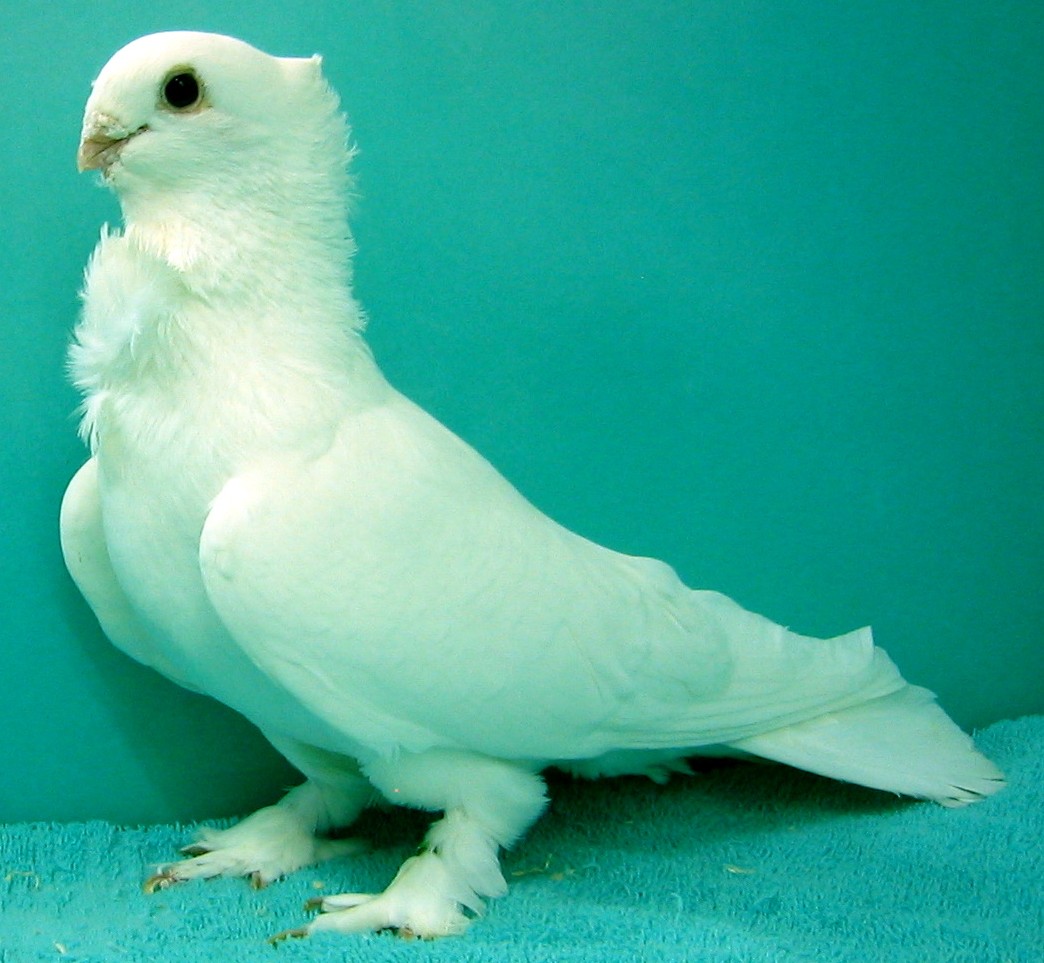
By four weeks the young are nearly fully feathered and almost ready to leave the nest. In an ideal world they will stay in the nest until they are five weeks old and truly fully feathered, but they often leave the nest in a controlled loft a bit early. By this same time, the cock has often already scouted out a new nest site if one is available and is encouraging the hen to lay another clutch. Once the new clutch is laid, the cock again resumes his daytime incubation duties but also attends to the older chicks which may now be running around on the floor of the loft, feeding them and teaching them to use the feeder and water source, which they learn quickly. He will do double duty until the next chicks hatch, and by then the older ones are already up on a roost and managing on their own.

Youngsters can be left with their parents for many months as more and more offspring are added. The parents tend to be tolerant of their own until they reach full maturity at eight months or more of age. As long as there are plenty of perches and the older juveniles stay away from the parental nest box, a large family of Seraphim will get along quite well. If space is tight or squabbles are noted, it is best to move the older youngsters out to their own pen so the parents can have some peace.

Caring for Your Seraphim Pigeons

[Editors Note: This is a reasonably detailed overview; nevertheless, the purchase of an exhaustive book covering every aspect of pigeon care, such as THE PIGEON GUIDE by Shannon Hiatt, available from Siegel’s at http://www.siegelpigeons.com is highly recommended for all pigeon owners. Happy reading!]

So, you’ve decided that you simply must have your own pair of Seraphim, and you’ve found a reputable loft and breeder from which to buy the best pair you can get. Are you properly prepared? Seraphim can live up to 13 years, perhaps longer, so it’s important to take good care of them. Most aspects of Seraphim care are no different than that for other fancy pigeon breeds. However, Seraphim DO have some peculiarities.

A healthy three  week old Seraph, the result of careful attention to the care of your adult Seraphim. Cute!

HOUSING
Seraphim, like all doves and pigeons, need room and fresh outdoor air. They not only like to fly; they need to fly. They are not birds to be kept in small cages, and if kept in the house as a pet they must have a large cage and ample opportunity to fly. They can tolerate extreme temperatures, hot and cold, and are naturally suited to do so. Unlike some fancy show pigeons, Seraphim are not hampered by form or feather characteristics that interfere with their ability to move about with ease.

A pair of Seraphim enjoying the sun, winter cold, and snow all at once!

The Loft. An ideal loft has room for breeding pairs, non-breeding cocks and hens, and young housed separately within the same or adjacent structures. This ideal situation is not always a reasonable option however, especially for those who live in cities or towns which restrict lofts and/or the number of birds one can maintain. A loft, which can be anything from an old chicken coop to a state-of-the-art high tech building especially designed for your birds with heat, cooling, running water, and computerized feeding systems and record keeping, is simply a structure in which pigeons and doves can live and raise their young in a healthy manner. They can be as small as 5×6 feet or as large as a gigantic machine shed, depending upon the goals of the loft keeper for his/her flock. European and Persian dovecotes (lofts) tend to be visions of architectural grandeur, frequently made of stone, brick, and stucco and with awesome design characteristics such as turrets, domes, landing niches, entrance and exit holes, and nest sites built into the walls. Such structures are a rarity in the United States, but it is certainly worth looking into such design possibilities if one has the interest.

A gorgeous (and expensive) stone and tile dove cote.

A lot of companies build small portable cedar sheds to order that can be modified with screened in porches, extra windows for light, cupolas, and entrance and exit doors for the birds. On the farm you may have an old brooder house or stone shed or garage that can be utilized. Organic spray foam insulation can help moderate temperatures inside throughout the year, and electrification can be extremely helpful. Do you need all of these things? No, you don’t. What you DO need is a building safe and secure from varmints and with adequate light and ventilation – that’s the bare minimum.

A little garden shed ready to be converted to a Seraphim loft.

Perches. Seraphim do not like tiny perches. They are strong and fairly large and enjoy walking about. An ideal perch for a Seraphim is really a ledge; thus mounting pine 2×4’s or wider boards or shelves on the walls is a good idea. They need such wide surfaces for standing when mating as well, though the floor of the loft will work as well. At night they want to perch as high up as possible to sleep, and even during daylight hours they tend to look for higher places to alight to preen and nap, so keep perches within reach but overhead. Dividing sleeping ledges into 14 inch sections using heavy cardboard stapled to the ledge at intervals is a good way to give each bird the room it needs to do what it wants without being hassled by the bird next to them. This isn’t an issue with a single pair, but the moment you have more than a pair, squabbles for space will ensue. There are a number of other options for perches, but keeping it simple is always good. Keeping perches clean can be difficult and time consuming though, so another option is to use the Lothar perch, a perch specially designed for fancy pigeons with feathered feet. The Lothar is a 4 inch round pedestal perch that attaches to the wall studs at an angle, the pedestal hovering about a foot and a half from the wall. It’s a great perch. Only one Seraph can fit, the pedestal never gets soiled, and it is large enough for standing, sitting, sleeping, and preening. All perches can be made by hand, and many types can be purchased through pigeon supply companies like Foy’s.

The “Lothar” perch attaches to the wall stud at an angle, the pedestal thus floating out from the wall leaving plenty of space and security for the Seraph.

Floor Bedding.Cover the floor lightly with a layer of straw, cedar chips, cob pellets, hay, or an equivalent absorbent material that allows for quick drying of droppings. This prevents disease and the soiling of feet and feathers. The bedding will need to be lightly fluffed and raked occasionally and changed completely every few months depending upon the number of birds making contributions to it. The droppings are high in nitrogen and phosphorous, an excellent enrichment material for garden soil and compost heaps.  My preference is a light layer of wood-pellet horse bedding covered loosely with Timothy grass; it’s super-absorbent and smells deliciously sweet and can be changed as infrequently as twice yearly. As long as the floor dries quickly, there is little risk of disease from droppings in a healthy flock. Many breeders are convinced that the presence of dried droppings enhances the health and immunity of their flock by assuring a normal healthy bacterial/yeast flora in the digestive systems of their birds.

Compressed wood pellet horse bedding and Timothy grass hay, one example of an appropriate floor material for Seraphim.

Flying Space. Having raised birds of all types since the age of 3, I can honestly say that creating an optimal aviary or flight has always been – for me – an incredibly difficult task. And believe me, I’ve tried literally everything to manage the tiniest of finches to gigantic peafowl and parrots to waterbirds of all types. The truth is that the best aviary is simply the great out-of-doors with no obstruction to free flight, and that is a tough act to follow. Free flight works wonderfully for birds that are domestic or attached enough to return to their building at night; it doesn’t work so well for those that are inherently wild or at unusual risk for predation. And Seraphim present some special problems in this regard. If they do happen to escape, having never been out, they tend to simply fly away and never look back. They are not great at homing either. The risk of loss is lower in the countryside and in the absence of trees and buildings interfering with a clear view of the loft, the obvious place to which to return. In town, the clutter of buildings and trees seems to startle an escaped Seraph and it doesn’t know what to do or where to go, so it just takes off. I know of one farm flock successfully allowed in and out every day from its loft; they were kept inside for several months first to get their bearings then allowed out through a small door with a landing pad; a large wall of the loft was chicken wire so the birds still inside could easily be seen and heard by those outside. This arrangement allowed the Seraphim to find their way back with no difficulty; the loft was also free and clear from overhanging trees and close buildings so it could clearly be identified as “home” from any angle. Nevertheless, Seraphim that felt crowded or that didn’t have mates would eventually leave of their own accord, and who knows what happened to them. Seraphim are prized by hawks, particularly the Sharp-Shinned Hawk and Cooper’s Hawk – natural bird hunters. The farm flock owner reported several instances during spring and fall hawk migrations of the loss of several Seraphim. Though fast fliers, the bright white color of a Seraph makes it an illuminated target for a hungry hawk. Those with little outdoor flying experience are quickly doomed. Other predators such as cats don’t do as well; Seraphim have an intense startle response and take to the air in a split second at the slightest disturbance, so they are generally quite unlikely to be caught by any ground-dwelling carnivores. So…the lesson is simple. Do NOT let your rare Seraphim fly free outside as a rule, and UNLESS you take precautions to make certain they will properly “home” and you have ascertained that there is very little – if any – risk of death due to predation. Do not let your show birds or best breeding birds fly free under any circumstances. They will certainly be lost at some point one way or another if you do.
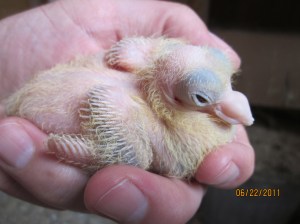
An 8×12 black-powder tubular steel dog kennel as aviary; note the door within a door, the birdbath, landing board under the windows, and ledge at the far end. The floor is covered with willow twig fencing.

Now then, having tried EVERYTHING for flights and aviaries, I can say without reservation that a metal powder-coated dog run is the best, easiest, and fastest way to make an outdoor flight for your Seraphim. The design I like best includes roof panels and is made by Northland Pet Supply Inc in British Columbia and available at a number of lumber yards and farm stores across the nation. The panels are 4×4 and 4×6 feet in size, the mesh is 2×4 inch, and a variety of entrance doors and locks are standard. They are easily put together with the supplied clamps, so one can go from having no aviary to an 8×12 in about four hours with ease. One end is simply abutted against the loft where the bird exit is located, and there you have it. The tubular steel is strong and will not disintegrate, the mesh is small enough to keep out major predators, and you can easily watch your birds. It’s a great product and is, I think, ideal for those who want a functional, solid, and yes, attractive flight for their Seraphim. The Seraphim bathing area can be kept outside where it belongs, and perches can be easily installed simply by hanging boards between the panel walls using exposed nails in the ends as “hooks.”

Having said all that, if you have a better design idea for a flight, use it! Then write about it and send the photos so I can show everyone else what you’ve done.

Light. Natural sunlight is a necessity for healthy birds. It is required for proper metabolism, bone health, hormonal balance, and breeding. So if your birds can’t get out, make sure natural sunlight can get IN! Artificial light is necessary for only two purposes: 1) to allow you to observe and work with your Seraphim in the early morning or late evening hours, especially during the winter months, and 2) to extend or start the breeding season, as the length of the day has a powerful influence on the instigation of meaningful mating behavior. A third reason could be that you live so far north or south that the length of day is too short for any good use, such as Alaska or Patagonia, but I’m going to assume most of our readers don’t have that issue to deal with!

NUTRITION

Water. It doesn’t seem that this should need to be a topic of discussion, but yet it is. Pigeons and doves drink a lot compared to other birds. Furthermore, they drink by plunging their beaks deep into the water and pumping it down their throats – none of the timid dipping that you see with other songbirds. So they need ample fresh water, and it needs to be deep enough for plunging. And when raising young, they need even more water to make crop “milk” for the newly hatched and to aid with regurgitative feedings for the older young. The babies will not drink on their own until they leave the nest; in the wild they would have to be totally capable of flight before the parents would stop assisting in delivering water to them.

A bullet waterer perched high on a ledge.

Water should be placed up off the floor to keep it free of dust and dirt from all the wind created by flapping wings. Don’t let your birds drink murky or filthy water. It probably won’t kill them, but acute or chronic diseases may ensue. There are a variety of waterers available for pigeons. One very useful type is called a “bullet” waterer. It’s designed to keep birds from landing on it and prevent soiling of the water. There are many other types available at pigeon supply stores; the main thing is to find a type that fits with your loft design and placement of the device to provide optimal access. When young squeakers are on the floor, water should be provided daily at their level. Once they are up on a perch and remain there for the night, they can access the regular water source. If your loft is not heated to keep it above freezing, you will need a heated water source. Seraphim cannot be allowed to be without water for more than a couple of days, so don’t let this happen.

Water can also be used for delivery of vitamins and medications and is generally the preferred method for both. If using supplements or treating your Seraphim for disease, be sure to follow the directions for dosing precisely. Variation from the recommended doses will poison and kill your birds.

Finally, Seraphim LOVE to bathe! They will do so daily if given the opportunity, regardless of the weather. A heated bath can be obtained from any farm store; the water simply has to be kept from freezing. Since they will drink it as well as bathe in it, change it daily or empty the pan at the end of the day if you don’t intend to refill it for a few days. They seem to prefer bathing in the mid-afternoon when the sun is warmest and will then stretch out on a ledge or on some warm sunlit bedding for a while, wings twitching with pleasure while they snooze. All pigeons make a powder called feather dust; you’ll see it as a white cloud billowing out when they fluff their feathers. The dust helps deter parasites and acts as a powerful water repellent. After a bath, you’ll see a thick film of powder floating in the water, and a white ring around the rim of the bath. It’s only feather dust. Replace the water with fresh clean water the next morning; they generally won’t use bath water from the previous day.

Feed. Nutrition for your Seraphim pigeons is a broad topic, broad enough to justify an in-depth read in a good pigeon guide reference book. Thankfully, nowadays it is easy to find a balanced seed diet for your Seraphim from specialty feed stores. The mix that most closely matches the needs of Seraphim is called the “King 45,” created by and available from Des Moines Feed in Des Moines, Iowa. Seraphim like a variety of seed sources, including millet, safflower, wheat, milo, rapeseed, and especially peas. Seraphim seem to have a need for more protein than other breeds of pigeons, and the mix must be heavy on peas as a result, and especially while feeding youngsters. In fact, they will let their youngsters starve if they do not have high protein feed; they simply will not feed them! So, peas are imperative. I keep an extra bag of pure peas handy so I can super-concentrate them during the breeding season by adding them to the King mix. During the summer the demand for Safflower goes up. This may be in preparation for the August molt; perhaps there is some essential element in Safflower that helps bring in healthy gorgeous feathers; all I know is that they want a lot of Safflower from late June into September. So then I add some extra Safflower to the King mix.
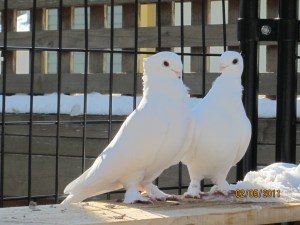
In general, feeding once per day is ideal. A pair of Seraphim eats only 1/4 cup of food per day, as long as it is protein rich as required. So measure it out, and don’t leave extra. This prevents food from spoiling and minimizes the risk of disease; it also reduces the risk of rodent invasions in the loft. It also enhances fertility; fat birds are not fertile birds. Do NOT overfeed, do NOT use “as needed” gravity feeders.  If you feed once daily, there should be nothing or very little left from the previous day’s feeding. An exception to this rule is when parents are breeding and feeding, as they may make two or three trips to the feeder to fill up the youngsters and still need more for themselves, a task that can take more time and demand a twice a day feeding schedule from you. Enough food should be placed to make certain neither the parents or young are left hungry. It is acceptable to leave enough food for a week or so when on vacation without much risk of trouble; just be sure to use appropriate feeders and place them in such a way that contamination of feed is unlikely, and don’t use this technique as a means of routine management.

Many breeders experiment with a variety of seed sources or put out a number of individual bowls of feed and study their birds’ response to get a sense of their natural inclination toward a variety of seed sources, or simply allow them to choose the seed they seem to want the most. Others make their own mixes. What the birds want tends to vary at different times of the year. Feeding exactly the same all the time is not likely to be the best approach and may result in nutritional deficiency over time.

Vitamins, Minerals, and Trace Elements. Seraphim need access to minerals and trace elements, such as calcium, manganese, phosphate, and iron. In the wild, pigeons find their own sources; how they know what to eat to get them is unknown. In your loft, a good source of calcium is oyster shell; they’ll take what they need. Cuttle bone works well if you have just a few birds, but is too difficult to manage for large flocks. Grit can be obtained at any farm store. “Pick-Stone” is a natural clay that has trace elements in it that seems to be important for optimal fertility and can be obtained at pigeon specialty stores such as Foy’s and Spiegel’s. Vitamins may need to be provided constantly in low doses. Some breeders place drops in the water every other week. I prefer mixing “Pink Powder” vitamin and nutrient mix into the feed bag,  stirring it in thoroughly in the top six inches and repeating each time that zone of feed is used up. Clearly pigeons in the wild are picking up all sorts of trace elements from the ground and outdoor water sources; we don’t really know why they seek out what they do or how they figure it out. Birds kept in a building do not have this option, so we have to get as close to what nature would provide as possible.

David Coster

United States Seraphim Breeders

The Seraphim Club International Pigeon Fanciers Group is a free site on Facebook for Seraphim fanciers, owners, and breeders who want to engage with others about Seraphim. The membership roster is active, so it is the best place to find other Seraphim fanciers.  
 
When you join the Facebook group you will automatically become a member of the Seraphim Club International. Request to join the “The Seraphim Club International Pigeon Fanciers Group” at:
 
 
Below is a roster of Seraphim breeders who are actively raising and breeding high quality Seraphim pigeons. The list will be updated annually and will also be posted on the “The Seraphim Club International Pigeon Fanciers Group.” If you are not on this list but you are breeding show quality Seraphim, please let me know at cozmd@aol.com so I can add you to the list of active Seraphim breeders:
 
Al Zuiches
Wisconsin
azuiches@yahoo.com
 
David Coster
Connecticut
cozmd@aol.com
 
David Sears
New Hampshire
riverbenz1@earthlink.net
 
Kevin Hiner
Texas
bluebarpd@gmail.com
 
Manuel Colchado
New Jersey
Mcolchado65@gmail.com
 
Pearlie Guerzo
Wisconsin
littlebeaksloft@yahoo.com
 
 
David Coster
Manager, Seraphim Club International
cozmd@aol.com